Finding a comfortable yet capable health tracker just got easier with the HK72 smart bracelet. This ultra-light 38g wearable disappears on your wrist with its barely-there 9.9mm metal body, proving you don't need bulk for advanced features. The vibrant 1.47-inch AMOLED screen delivers crisp notifications and health data at a glance, while the 10-day battery life outlasts most smartwatches.


What sets the HK72 apart is its thoughtful health tracking. It automatically monitors your heart rate and blood oxygen around the clock, with special attention to women's health through menstrual cycle tracking. The sleep analysis breaks down your REM cycles, while the stress monitor suggests breathing exercises when tension rises. Unlike complex smartwatches, it presents this data simply through an intuitive interface.


For active users, the IP68 waterproof rating means no workout is off-limits - whether swimming laps or running in rain. The bracelet automatically detects exercise types and tracks progress through three motivational activity rings. Smart features like Bluetooth calling and offline Alipay payments add convenience without complicating the experience. With multiple stylish watch faces and an always-on display option, the HK72 blends seamlessly into both gym sessions and business meetings - a rare balance of form and function in wearable tech.

Ultra thin AMOLED smart braceletOEM smart bracelet supplierCustom logo fitness trackers

We are a factory that has designed and produced LED fountain lamps for 15 years, with a stable engineering and sales team.Over the past 15 years, we have also encountered a problem that a small number of products may stop working after a few years of use.


Typically, these DMX or RDM lights are installed in fountains, pools, plazas, or artificial lakes. Therefore, if a product stops working, it is a huge undertaking to maintain them. The conventional method involves draining the pool or fountain, removing and opening the device's junction box, removing the defective unit, and then rewiring and replacing it with a new one. This task becomes unimaginable in an artificial lake.


For example, Have a look next pictures, which happened in a fountain pool,All cables from light to junction box have 10 meters. However, two units lights stopped work and you must replace them.

LED Fountain pool lights


LED Swimming Pool Lights

Our team has upgraded product design, which not only improves the waterproof quality of our products, but also helps customers optimize the repair process.All our products have waterproof designs for PCB and DMX/RDM decoders. The entire PCB is mounted in a 2.5mm thick aluminum bowl for improved heat dissipation, and the PCB is sealed with IP68-rated waterproof adhesive. Similarly, the DMX/RDM decoder is housed in a white plastic bowl, also sealed to IP68 standards. As the picture we did,


Therefore, no matter how complex the environment, maintenance personnel only need to remove the light from the Nozzle in Fountain, open the lamp cover, replace the LED PCB/decoder inside, and re-tighten the cover screws evenly. which basically completes the repair work. This eliminates the need to remove the waterproof box, reconnect the power and signal cables, or even drain the water of pool.

By following a few simple steps, the fountain light can be restored to its original state.

Waterproof LED Fountain Light


Outdoor LED Fountain Light


Furthermore, for lights beyond their warranty, repair costs are minimal. Customers only need to re-purchase the PCB and DMX/RDM decoders, and several waterproof gaskets (screws are provided free of charge). Compare with purchase finished lights, Purchase cost and expensive international shipping costs can be saved, as the PCB/decoders has so light weight.

In industrial automation, robotics, and precision instruments, connector performance is often the “invisible bottleneck” that limits system reliability. Traditional connectors can be hard to route in tight spaces, difficult to service, and prone to interference. WAIN’s MI Series miniature high‑density connectors give engineers a space‑saving, easily maintained, high‑reliability alternative.

MI Series Miniature High‑Density Connectors


Break the Space Barrier 


· MI connectors feature a compact form factor that is smaller than conventional products while integrating three functional modules—signal, power, and brake—into a single unit. This eliminates cable clutter and frees up valuable enclosure space, making the connectors easy to embed in robot joints, AGV control bays, or precision-instrument compartments.

· A partitioned, removable-module design allows users to detach either the signal or power section independently. If one module fails, the entire connector does not need to be replaced, dramatically reducing maintenance time and cost. Compared with traditional one-piece connectors, service efficiency is significantly improved.


Five Core Technology Innovations


1、One-Second Quick-Release — Latch Mechanism
MI connectors use an elastic latch-lock design that mates or unmated with a single press, cutting installation time. Anti-mis-mate coding ensures precise, reliable connections.

2、Vibration-Resistant Cold-Crimp Contacts
Contacts are cold-crimped—no soldering—delivering high-strength conductivity. Tested to withstand 500+ mating cycles, ideal for high-vibration environments such as industrial robots and rail systems.

3、360° Electromagnetic Shielding + Partitioned Isolation
Dual-layer protection:
• Outer full-metal shell blocks external EMI.
• Inner isolation chambers physically separate power and signal sections, eliminating crosstalk and guaranteeing zero-packet-loss data transmission.

4、Dual-Cable Exits for Flexible Routing
Independent power and signal channels exit through Ø 7.5 mm ports, accommodating large-gauge power and fine-gauge signal wires. The plug supports 180° dual-direction swivel, adapting to varied equipment layouts.

5、Visual Assembly — Top + Side Inspection Windows
Technicians can verify pin alignment in real time, preventing bent pins from blind mating. During service, windows enable rapid fault location, lowering technical complexity and downtime.


Proven in Harsh Environments


·Operating temperature: –40 °C … +130 °C

·Ingress protection: IP67 (mated, EN 60529) – suitable for aerospace and outdoor equipment

For outdoor enthusiasts who split their weekends between trailblazing, stargazing campsites, and river kayaking, finding a watch that marries functionality with simplicity has long been a challenge. TERRAX steps in as the solution, blending practical design with a "Travel Light" ethos that resonates with those who prioritize the journey over the gadget.​


Its appeal starts with a clutter-free approach: no overcomplicated interfaces or redundant apps, just a streamlined design that lets adventurers focus on the experience rather than navigating menus. The lightweight build is a standout feature—perfect for 10-mile hikes where every ounce matters. The ultra-light nylon strap, soft yet sturdy, feels barely there, even during all-day wear.​


Small but thoughtful details elevate its usability in the wild. Physical buttons, a deliberate choice over touchscreens, ensure reliable operation whether users are wearing thick gloves mid-climb or have wet hands after a sudden downpour. When twilight fades to darkness, the military-grade green glow illuminates the entire dial, turning pitch-black forests or moonless campsites into spaces where time stays visible.​


Eco-conscious materials add depth to its appeal, aligning with the values of outdoor lovers who strive to minimize their environmental footprint. Nature-inspired color palettes—subtle greens and earthy tones—blend seamlessly with wilderness backdrops, making it as much a style statement as a tool.​


TERRAX doesn’t aim to compete with smartwatches. Instead, it excels as a reliable companion, built to keep pace with the most rugged adventures. For those who need timekeeping that fades into the background until it’s needed, it’s the perfect fit.

 Custom logo outdoor watch supplier

In the highly competitive electronic equipment market, a product with outstanding performance can often help you stand out. The quality of core magnetic components is crucial to the performance of the equipment. We recognize that each customer has unique needs, which is why we specialize in customizing products for you. Our offerings span transformers, high-frequency inductors, current transformers, as well as transformer bobbins, transformer clips, transformer bases, and copper wires, providing a one-stop customization service to boost your equipment's capabilities.

When your equipment demands stable and efficient voltage conversion, high-frequency electronic transformers play a vital role. While universal transformers may suffice in some cases, customized transformers can precisely match your equipment's power, voltage, and other parameters, minimizing energy loss and enhancing operational efficiency. Whether it's the strict low electromagnetic interference requirements for medical devices or the high stability needs of industrial machinery, we can optimize magnetic core materials and winding processes to make the customized transformer a reliable "energy hub" for your equipment, giving you an edge in market competition.

Customized Flyback Transformer

High-frequency inductors are indispensable in high-frequency circuits, and their performance directly impacts the signal transmission and stability of the equipment. Standardized products struggle to adapt to the varying high-frequency environments of different devices. However, our customization service can tailor high-frequency inductors based on your equipment's operating frequency, space constraints, and other factors. By precisely designing the winding method and selecting the right magnetic core, we can effectively reduce high-frequency losses, ensuring your equipment remains stable during high-speed operation, enhancing product competitiveness, and winning more customer trust.

SMD servo motor driver transformer

The safe operation of power systems relies on accurate current monitoring, and current transformers are the key components to achieve this. Different power equipment has varying requirements for the accuracy and range of current monitoring, and customized precision current transformers can perfectly meet these needs. We will optimize the core design and winding turns according to your application scenarios, ensuring accurate current signals are provided under all complex working conditions. This provides strong support for the safe and stable operation of power systems, making your products more trusted in the market.

 Potting ferrite cores for transformers

High-quality transformers require support from complementary accessories, and electronic transformer bobbins are an important part of this. Customized transformer bobbins not only precisely fit the structure of the transformer to ensure stable windings but also use appropriate materials based on the equipment's working environment, improving insulation performance and durability. Transformer clips can firmly secure the transformer, preventing vibrations during equipment operation from affecting it and ensuring the transformer remains in a stable working state.

Power switch transformer

The customization of electronic transformer bases is also essential. They not only provide support but also assist in heat dissipation for the transformer. For high-power transformers, we design transformer bases with efficient heat dissipation structures to promptly dissipate heat generated during operation, extending the transformer's service life. Transformer winding wires, as the core material of transformer windings, directly affect the transformer's performance. We provide customized copper wires based on the transformer's power and current requirements, ensuring smooth current transmission, reducing energy consumption, and making your equipment more energy-efficient and effective.

From core components to complementary accessories, our customization services cover transformers, high-frequency inductors, current transformers, as well as transformer bobbins, transformer clips, transformer bases, and enameled wires. We take meeting your needs as our starting point, using professional technology and attentive service to create high-quality customized products for you, helping your equipment stand out in the market. Choose our customization service to let every component add value to your products and embark on a path to success together.


Contact us today to explore bulk orders or request technical specifications.

Email: sales008@mycoiltech.com

WeChat ID: MCT008Alex

In the design of transformers, inductors and other electromagnetic components, there is a seemingly tiny but far-reaching detail - the “magnetic core air gap”. This small gap (usually in millimeters or even micrometers) reserved at the junction of various cores such as EE electronic transformer cores, EI transformer cores, and GU pot-type transformer cores, though simple, is like an "invisible engineer" that silently determines the efficiency, stability and service life of the equipment. Today, we will uncover the mystery of magnetic core air gaps and see how they become the "finishing touch" to improve the performance of electromagnetic components such as EFD transformer cores and EF transformer cores.

EE series drive transformer


1. Say Goodbye to "Magnetic Saturation" and "Relax" the Magnetic Core

The magnetic core is the "energy warehouse" of electromagnetic components, responsible for storing and transmitting magnetic field energy. However, any magnetic core material has its "bearing limit" - when the current through the coil is too large, the magnetic field strength exceeds the saturation point of the material, and magnetic saturation will occur. Once saturated, the magnetic permeability of the core will drop sharply, which not only causes a sharp drop in energy transmission efficiency, but also leads to severe heating of the coil and even damage to the equipment.

The core function of opening an air gap in the magnetic core is to reduce the effective permeability of the core, thereby increasing its saturation flux density. Both EE transformer cores, which are widely used in the power supply field, and EI transformer cores, which are common in traditional transformers, can benefit from opening air gaps. To put it metaphorically, it's like adding a "pressure relief valve" to the "energy warehouse": the GU series pot-type transformer cores that were originally easy to be "filled" can accommodate more magnetic field energy due to the existence of air gaps, and are not easy to saturate even under high current conditions. This is a "lifesaver" for EFD transformer cores and EF transformer cores commonly used in high-frequency transformers that need to carry large currents - it can keep the equipment stable during full-load operation and avoid efficiency collapse caused by saturation.

pot electronic transformer frame


2. Stabilize the Inductance Value and Make the Circuit "More Obedient"

In inductor design, the stability of inductance directly affects the circuit performance. Without an air gap, the permeability of EE transformer cores, EI transformer cores, etc. will fluctuate greatly with changes in current, resulting in fluctuating inductance values, and the circuit will be like a "runaway wild horse" that is difficult to control.

After opening an air gap, an air gap is introduced into the magnetic circuit of the core (the permeability of air is much lower than that of the core material), so that the permeability of the entire magnetic circuit is mainly determined by the length of the air gap, not by the core material itself. This means that even if the current changes, the inductance values of GU pot-type transformer cores and EFD transformer cores can remain stable. For scenarios that require precise control of energy transmission - such as switching power supply filter inductors using EF transformer cores and new energy vehicle charging pile inductors using EE transformer cores - this stability is crucial. It can keep the circuit "obedient" at all times, reduce ripple interference, improve the purity of the output voltage, and ultimately improve the reliability of the entire equipment.


3. Optimize Heat Dissipation and Extend Equipment "Service Life"

Under high-frequency working conditions, heat dissipation of electromagnetic components is a major problem. Eddy current losses when the core is saturated and copper losses of the coil will be converted into heat, which will accelerate the aging of components if not dissipated in time.

After opening an air gap in the magnetic core, due to the avoidance of magnetic saturation, eddy current losses will be significantly reduced, and the magnetic field distribution at the air gap is more uniform, reducing the risk of local overheating. EI transformer cores can effectively reduce the temperature rise of traditional power frequency transformers through reasonable air gap opening; GU pot-type transformer cores, with their closed structure and optimized air gap design, have greatly improved heat dissipation efficiency. In addition, the segmented air gap design adopted by  PQ high-frequency transformer cores and ETD series transformer cores can also reduce magnetic leakage at the core joints, reducing electromagnetic interference and additional losses of surrounding components. For long-term operation of industrial equipment, automotive electronics and other "long-life demand" scenarios, this means that the temperature rise of components is lower, the aging speed is slower, and the overall service life of the equipment is naturally longer.

PQ series power switch transformer

4. Adapt to High-Frequency Scenarios and Let Energy "Run Fast"

In high-frequency circuits (such as 5G base station power supplies, fast chargers), the magnetic core needs to respond quickly to current changes to achieve efficient energy conversion. EE transformer cores and EFD transformer cores without air gaps, due to their high permeability, are prone to hysteresis losses at high frequencies, slowing down energy transmission.

After opening an air gap, the high-frequency characteristics of the magnetic core are optimized: hysteresis losses are reduced, and energy conversion speed is accelerated. It's like installing "high-speed gears" for the magnetic core, allowing the EI series transformer cores to adapt to rapid energy conversion after high-frequency transformation, and enabling the GU pot-type transformer cores to operate efficiently in a closed environment. For example, the high-frequency transformers using EF transformer cores in our common mobile phone fast chargers can fully charge the phone in just half an hour through precisely designed core air gaps - ensuring high-power output while avoiding overheating problems.

EI series household appliance switch transformer


Choose the Right Air Gap Design to Make Your Products "Stand Out"

Of course, opening an air gap in the magnetic core is not "the larger the better": if the air gap is too small, it cannot play the role of anti-saturation; if the air gap is too large, it will lead to increased magnetic leakage and increased losses. Whether it is EE transformer cores, EI transformer cores, GU pot-type transformer cores, EFD transformer cores, or EF transformer cores, a truly excellent design is to accurately calculate the air gap length and distribution (such as single-segment air gaps, multi-segment air gaps) according to the equipment's power, frequency, current and other parameters to achieve a "perfect balance between performance and loss".

Whether it is EFD transformer cores used in consumer electronics fast charging power supplies, EE transformer cores in industrial automation servo drives, or EF transformer cores used in new energy inverters, magnetic core air gaps are the "invisible weapon" to improve product competitiveness. It seems small, but it directly determines whether the equipment can be "stable as a mountain" under complex working conditions and stand out among similar products with "high efficiency and long service life".

If you are worried about the stability, efficiency or service life of your products, you might as well check whether the EI transformer cores, GU pot-type transformer cores you use have "opened the right air gaps" - sometimes, a small design optimization can make your equipment performance achieve a "qualitative leap".

Our mycoiltech company has been deeply engaged in the electronic components industry for many years, with its own factory and professional engineering team, and is well versed in the design and manufacturing essence of various magnetic cores and related components. We can provide customers with customized electronic components supporting services, whether it is EE, EI, GU pot-type, EFD, EF and other series of transformer cores, or transformer bobbins, clips, bases, as well as inductors, high-current transformers, etc., can be accurately customized according to your specific needs. By choosing us, you will not only get high-quality products that meet strict standards, but also full-process high-quality services from design consultation to after-sales support, making your products more advantageous in the competition.


Contact us today to explore bulk orders or request technical specifications.

Email: sales008@mycoiltech.com

WeChat ID: 

Electronic component factory


How Rogers RT/duroid 6010.2LM Achieves Ultra-Low Loss and Stable 10.2 Dk for Compact X-Band PCBs


Introduction

In the rapidly advancing world of high-frequency electronics, achieving optimal performance demands specialized materials engineered for precision and reliability. Rogers Corporation's RT/duroid 6010.2LM laminates stand at the forefront of this technology, offering an exceptional ceramic-Polytetrafluoroethylene (PTFE) composite solution. Specifically formulated for circuits operating at microwave frequencies where stringent electrical characteristics are non-negotiable, this laminate leverages its high dielectric constant (Dk) to enable significant circuit miniaturization. By facilitating more compact and highly efficient designs, the 6010.2LM empowers engineers to push the boundaries of size and performance. Its exceptionally low loss properties make it the substrate of choice for critical applications operating within the X-band spectrum and lower frequency ranges, where signal integrity is paramount.


Advanced Features

The Rogers 6010.2LM laminate distinguishes itself through a suite of meticulously controlled properties designed to deliver consistent, high-performance results:


2.1 Exceptional Dielectric Constant (Dk) Control:

Boasting a high Dk value of 10.2 coupled with an impressively tight tolerance of±0.25, the 6010.2LM provides unparalleled stability in electrical performance. This precise Dk control is fundamental for predictable impedance management and resonant frequency accuracy, ensuring consistent, repeatable circuit behavior essential for high-yield manufacturing and reliable end-use operation.


2.2 Ultra-Low Dissipation Factor (Df):

Signal loss is a critical enemy in high-frequency applications. The 6010.2LM substrate combats this effectively with an exceptionally low dissipation factor of just 0.0023 measured at 10 GHz. This ultra-low loss characteristic minimizes signal attenuation and distortion over distance and through components, facilitating highly reliable and efficient signal transmission crucial for sensitive communication and radar systems.


2.3 Flexible Copper Foil Options:

Recognizing the diverse needs of PCB fabrication and performance optimization, the Rogers 6010.2LM PCB offers a choice between Electro-Deposited (ED) copper and Reverse-Treated Foil (RTF) copper. This critical flexibility allows designers and manufacturers to tailor their selection based on specific requirements, whether prioritizing ultra-low insertion loss for signal integrity, minimizing Passive Intermodulation (PIM) for sensitive receivers, or optimizing surface roughness for bonding and etching processes.


2.4 Minimal Moisture Absorption:

Environmental resilience is key for long-term reliability. The 6010.2LM laminate exhibits very low moisture absorption characteristics. This inherent resistance to humidity helps preserve its stable electrical properties (like Dk and Df) over time and under varying environmental conditions, reducing performance drift and enhancing the operational lifespan of the PCB.


2.5 Optimized Coefficient of Thermal Expansion (CTE): 

Thermal management is critical, especially in complex multi-layer structures. The CTE values for the RT/duroid 6010.2LM are carefully engineered at 24 ppm/°C in the X and Y axes, and 47 ppm/°C in the Z-axis. This specific CTE profile is crucial for enhancing the long-term reliability of plated through-holes (PTHs) in multi-layer boards. It helps minimize stress during thermal cycling, ensuring robust and secure electrical connections between layers, thereby contributing significantly to the overall structural and functional integrity of the assembly.


6010.2LM PCB Features


Demonstrated PCB Manufacturing Capabilities with 6010.2LM

Leveraging the advanced properties of Rogers RT/duroid 6010.2LM requires a manufacturing partner with proven expertise and versatile capabilities. We possess the specialized processes and stringent quality controls necessary to fully harness the potential of this demanding material:


3.1 Complex Configurations:

We expertly manufacture a wide array of board structures to meet diverse design challenges, including Single Sided, Double Sided, sophisticated Multi-layer builds, and Hybrid constructions combining 6010.2LM with other compatible materials (like FR-4 or other RF laminates) to optimize cost and performance.


3.2 Material Thickness & Copper Weight Flexibility:

We offer standard dielectric thicknesses of 10mil (0.254mm), 25mil (0.635mm), 50mil (1.27mm), 75mil (1.90mm), and 100mil (2.54mm). Copper weights of 1oz (35µm) and 2oz (70µm) are standard, with other weights potentially available upon request, providing design flexibility for current carrying capacity and impedance control.


3.3 Generous Panel Sizing & Solder Mask Options:

Our manufacturing process accommodates panel sizes up to 400mm x 500mm, optimizing material utilization for larger boards or efficient panelization. Aesthetic and functional requirements are met with a range of solder mask colors, including Green, Black, Blue, Yellow, Red, and more.


3.4 Comprehensive Surface Finishes:

To ensure optimal solderability, wire bondability, shelf life, and electrical performance, we provide a full spectrum of surface finish options. Choose from Bare Copper, HASL (Lead-Free), ENIG (Electroless Nickel Immersion Gold), Immersion Tin, Immersion Silver, OSP (Organic Solderability Preservative), Pure Gold (Hard/Soft), ENEPIG (Electroless Nickel Electroless Palladium Immersion Gold), and others based on your specific application needs.


3.5 High-Frequency Expertise:

Our processes are specifically refined for handling low-Df, tight-tolerance RF PCB materials like 6010.2LM, focusing on precise etching, lamination control, and meticulous drilling to maintain impedance accuracy and signal integrity.


6010.2LM PCB capability


Critical Applications Enabled by RT/duroid 6010.2LM PCBs

The unique combination of high Dk, ultra-low loss, and excellent stability makes RT/duroid 6010.2LM PCBs indispensable in a variety of demanding high-frequency applications where performance, reliability, and size are critical factors:


Patch Antennas & Phased Arrays: Enables compact, efficient radiating elements with precise beam patterns, ideal for communication links and radar systems.


Satellite Communications (Satcom) Systems: Provides the stable, low-loss platform needed for uplink/downlink transceivers and onboard processing in harsh space environments.


High-Power Amplifiers (HPAs): Supports efficient power transfer and thermal management in amplifiers for radar and communication transmitters.


Avionics & Radar Systems: Critical for aircraft collision avoidance systems (ACAS/TCAS), ground radar warning systems, altimeters, and weather radar, where reliability and signal clarity are paramount for safety and mission success.


Military & Defense Electronics: Used in radar systems (ground-based, naval, airborne), secure communications, electronic warfare (EW), and guidance systems requiring robust performance.


Telecommunications Infrastructure: Found in high-frequency base station components, point-to-point microwave backhaul links, and emerging 5G/6G infrastructure where low loss and size efficiency are crucial.


Rogers 6010.2LM PCB


How Rogers RT/duroid 6010.2LM Achieves Ultra-Low Loss and Stable 10.2 Dk for Compact X-Band PCBs


1. Material Composition: Engineered Ceramic-PTFE Composite

The foundation of RT/duroid 6010.2LM’s performance lies in its proprietary ceramic-PTFE (polytetrafluoroethylene) composite. This hybrid structure synergizes:


Ceramic fillers (e.g., alumina): Provide high dielectric constant (Dk=10.2) through dense polarizable molecules.


PTFE matrix: Delivers ultra-low loss by minimizing dipole relaxation losses at microwave frequencies.

The homogeneous dispersion of ceramics in PTFE suppresses energy dissipation mechanisms, achieving a dissipation factor of 0.0023 at 10 GHz–critical for X-band (8–12 GHz) efficiency.


2. Precision Dk Stability: Tolerance Control (±0.25)

Stability is ensured through:


  • Controlled filler distribution: Uniform ceramic particle size eliminates localized Dk variations.
  • Cross-linked PTFE: Enhances molecular rigidity, reducing thermal drift.


Moisture resistance: <0.1% water absorption prevents Dk fluctuations in humid environments.

This allows impedance tolerances≤1%–vital for phased-array antennas and filters where phase consistency impacts beamforming.


3. Loss Mitigation Mechanisms

Ultra-low signal attenuation results from:


  • Minimal conductor roughness: RTF copper options reduce skin effect losses at X-band frequencies.
  • PTFE’s non-polar nature: Lacks ionic impurities that cause dielectric relaxation.
  • Low hysteresis: Ceramic-PTFE bonds dissipate minimal heat under RF cycling.


This preserves signal integrity in high-power amplifiers and radar systems.


4. Miniaturization Advantages

The high Dk (10.2 vs. FR-4’s ~4.5) enables wavelength reduction by >50% via: 


  • Shorter trace lengths: Resonant structures (e.g., patch antennas) shrink proportionally to 1/√Dk.
  • Reduced layer counts: High Dk allows multi-layer consolidation without crosstalk.


Example: A 10 GHz microstrip antenna on 6010.2LM occupies ~60% less area than on low-Dk substrates.


5. X-Band Optimization

Performance at X-band leverages:


  • Flat dispersion curve: Dk varies <2% from 5–15 GHz, avoiding phase distortion.
  • CTE matching: In-plane CTE (24 ppm/°C) aligns with copper, preventing delamination during thermal cycling in avionics.
  • Z-axis stability: 47 ppm/°C CTE ensures plated through-hole reliability in multi-layer boards.


Conclusion

RT/duroid 6010.2LM high frequency PCB achieves its benchmark performance through material physics innovation: Ceramic fillers enable high Dk/size reduction, while PTFE delivers loss control. Tight process tolerances (±0.25 Dk), moisture resistance, and CTE engineering then translate these properties into reliable X-band operation. For designers, this means compact, high-Q circuits with uncompromised signal fidelity in radar, satcom, and 5G infrastructure.


Rogers RT/duroid 6010.2LM high-frequency laminates represent a superior material solution for engineers pushing the limits of microwave circuit design. Its tightly controlled dielectric properties, ultra-low loss, environmental stability, and thermal reliability make it ideal for the most demanding applications in aerospace, defense, telecommunications, and advanced sensing. As your specialized PCB manufacturing partner, we combine deep expertise in processing this advanced material with comprehensive capabilities–from complex multilayer and hybrid constructions to diverse finishing options–to deliver high-performance PCBs tailored to your exact specifications. Partner with us to leverage the full potential of RT/duroid 6010.2LM and achieve unparalleled success in your next high-frequency project.


Rogers TC350 PCB: High-Performance RF & Microwave Solution for Enhanced Thermal Management


Introduction

In the rapidly evolving world of high-frequency electronics, thermal management and signal integrity are critical for optimal performance.Rogers TC350 laminates are advanced PTFE-based composite substrates engineered with highly thermally conductive ceramic fillers and woven glass reinforcement, delivering exceptional thermal conductivity to improve heat dissipation. This unique composition minimizes dielectric and insertion losses, leading to higher gain and efficiency in amplifiers, antennas, and other RF/microwave applications.


One of the standout advantages of Rogers TC350 PCB is its ability to handle higher power levels while reducing hotspots, significantly enhancing device reliability. In designs where thermal management is limited, TC350 substrates improve heat transfer, lowering junction temperatures and extending the operational lifespan of active components. Additionally, its lower operating temperatures and compatible thermal expansion properties with semiconductor chips ensure stronger component attachment, reducing common failure modes such as solder fatigue and joint cracking.


Key Features and Benefits of Rogers TC350 PCB


1. Stable Dielectric Constant (Dk) for Precise Impedance Control

Rogers TC350 laminates feature a dielectric constant (Dk) of 3.5, ensuring consistent signal integrity and precise impedance control in high-frequency circuits. This stability is crucial for applications requiring low signal distortion, such as 5G infrastructure, radar systems, and satellite communications.


2. Superior Thermal Conductivity for Efficient Heat Dissipation

With an outstanding thermal conductivity of 0.72 W/m-K, TC350 PCBs effectively dissipate heat through the laminate, preventing thermal buildup that can degrade performance. This property is particularly beneficial in high-power RF amplifiers and base station antennas, where excessive heat can lead to premature failure.


3. Low Thermal Coefficient of Dk for Temperature Stability

The thermal coefficient of Dk for TC350 is an impressively low -9 ppm/°C (within the range of -40°C to 140°C), meaning that the material’s dielectric properties remain stable even under extreme temperature fluctuations. This ensures reliable signal transmission in harsh environments, such as aerospace and automotive radar systems.


4. Ultra-Low Loss Tangent for Minimal Signal Loss

At 10 GHz, Rogers TC350 exhibits an exceptionally low loss tangent of 0.002, which translates to minimal signal attenuation. This characteristic allows for better bandwidth utilization, making it ideal for high-frequency amplifiers, filters, and antenna systems that demand high efficiency and low noise.


5. Excellent Dimensional Stability with Low CTE

The coefficients of thermal expansion (CTE) for TC350 are well-controlled across all axes:


  • X & Y-axis: 7 ppm/°C
  • Z-axis: 23 ppm/°C


This low CTE ensures reliable plated through-hole (PTH) connections and superior dimensional stability, preventing warping or delamination during thermal cycling. As a result, this custom TC350 PCBs maintain long-term reliability in demanding applications.


TC350 Features


PCB Manufacturing Capabilities for Rogers TC350

As a reliable PCB supplier, we offer advanced fabrication services tailored to Rogers TC350 laminates, ensuring high-quality, high-performance boards for your RF and microwave applications.


1. Board Configurations

Single-sided, double-sided, and multi-layer PCBs

Hybrid constructions (combining Rogers TC350 with other high-frequency materials like RO4003C or FR4)


2. Copper Weight Options

1 oz (35 µm)–Standard thickness for signal integrity

2 oz (70 µm)–Enhanced current-carrying capacity for power applications


3. PCB Thickness & Size

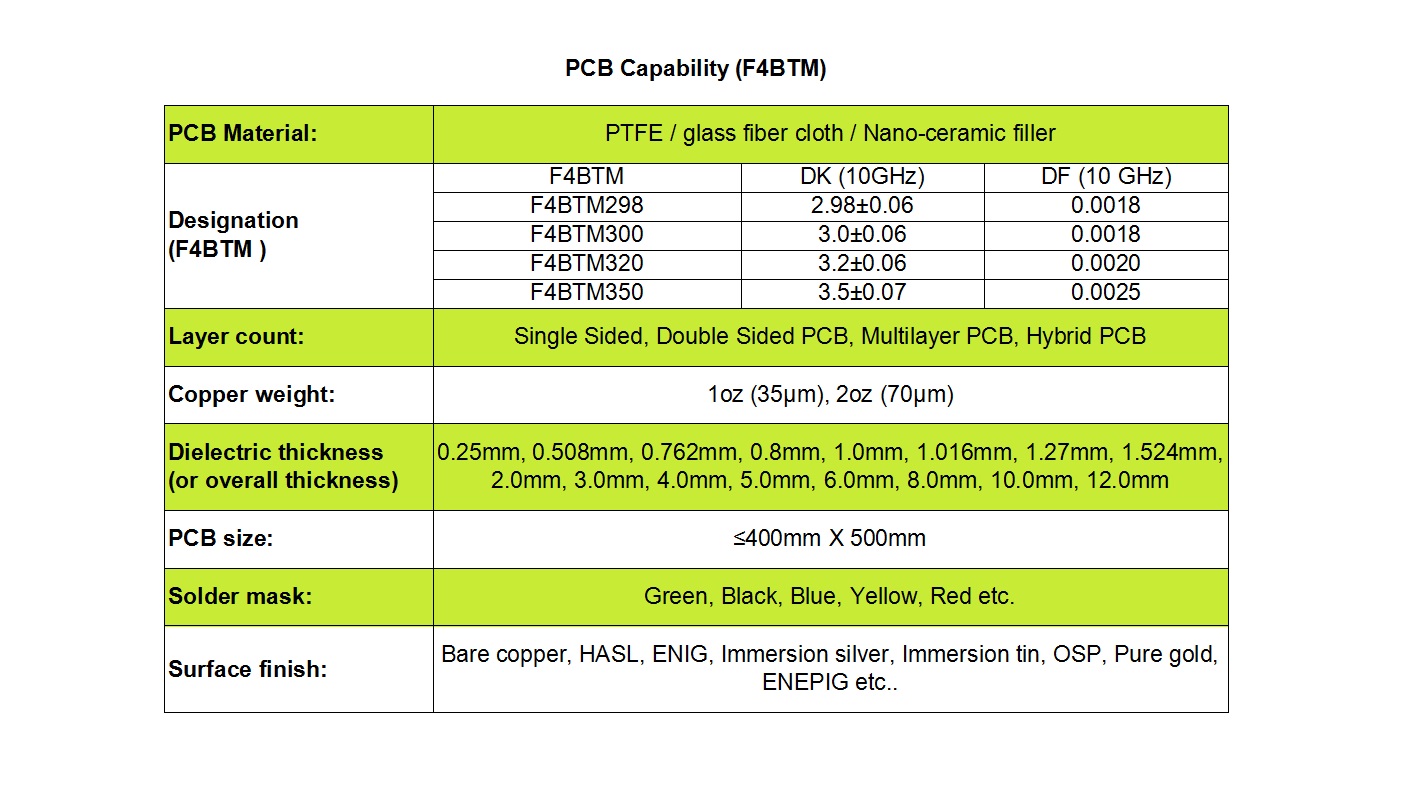
Available thicknesses: 10 mil, 20 mil, 25 mil, 60 mil, 125 mil

Maximum PCB size: 400 mm×500 mm


4. Solder Mask & Surface Finishes

Solder mask colors: Green, black, blue, yellow, red

Surface finishes: Bare copper, HASL, ENIG, OSP, immersion silver, immersion tin, ENEPIG, pure gold


TC350 PCB Capability


Applications of Rogers TC350 PCB

Due to its exceptional thermal and electrical properties, Rogers TC350 is widely used in high-frequency and high-power applications, including:


  • Power amplifiers (for 5G, radar, and satellite communications)
  • RF filters & couplers
  • Tower-mounted amplifiers (TMA) & boosters (TMB)
  • Microwave combiners & power dividers
  • Military & aerospace electronics
  • Automotive radar & ADAS systems


 Rogers TC350 boards


Conclusion

TC350 high frequency PCB is a high-performance solution for demanding RF and microwave applications, offering superior thermal management, stable electrical properties, and excellent reliability. Whether you need high-power amplifiers, low-loss filters, or high-efficiency antennas, TC350 laminates provide the thermal and electrical stability required for optimal performance.


As an experienced PCB supplier, we specialize in producing high-quality Rogers TC350 boards tailored to your specifications. Contact us today to discuss your project requirements and leverage the benefits of this advanced material for your next high-frequency design!


Why Choose RO4350B Over PTFE for Cost-Effective High-Frequency PCBs?


Introduction to RO4350B High Frequency PCB

In the realm of high-frequency printed circuit boards (PCBs),Rogers RO4350B stands out as a high-performance material engineered for demanding RF and microwave applications. This advanced laminate combines a proprietary blend of woven glass-reinforced hydrocarbon/ceramic materials, delivering electrical performance on par with PTFE/woven glass while maintaining the manufacturability benefits of traditional epoxy/glass laminates.


RO4350B laminates provide exceptional control over dielectric constant (Dk) while ensuring minimal signal loss. Unlike PTFE-based materials, which often require specialized handling and through-hole treatments, Rogers 4350B can be processed using standard FR-4 fabrication techniques, significantly reducing production costs and lead times. Additionally, these materials meet the stringent UL 94 V-0 flammability rating, making them ideal for high-power RF designs and active electronic devices where reliability is critical.


Key Features of RO4350B High Frequency PCB


1. Low Dielectric Constant for Enhanced Signal Integrity

RO4350B laminates exhibit a stable dielectric constant (Dk) of 3.50 at 10 GHz, ensuring consistent signal propagation in high-frequency circuits. A low Dk is essential for minimizing signal delay and distortion, making RO4350B an excellent choice for high-speed digital and RF applications.


2. Ultra-Low Dissipation Factor for Minimal Signal Loss

With a dissipation factor (Df) of just 0.0017 at 10 GHz, RO4350B PCB ssignificantly reduce signal attenuation, preserving signal integrity even in high-frequency environments. This low-loss characteristic is crucial for applications such as 5G communications, radar systems, and satellite technology.


3. Excellent Thermal and Dimensional Stability

RO4350B offers outstanding dimensional stability, with a Z-axis coefficient of thermal expansion (CTE) of 24 ppm/°C, closely matching that of copper. This alignment prevents delamination and ensures reliable performance under thermal stress. Additionally, the material boasts a glass transition temperature (Tg) exceeding 280°C (536°F), enabling it to withstand high-temperature assembly processes such as lead-free soldering without warping or degradation.


4. Superior Mechanical and Environmental Resistance

Engineered for durability, RO4350B substrate PCBs resist moisture absorption and environmental factors that could compromise performance. Their robust construction ensures long-term reliability in harsh operating conditions, making them suitable for aerospace, defense, and automotive applications.


RO4350B Features 


PCB Manufacturing Capabilities for RO4350B

We provide a comprehensive range of fabrication options to meet diverse design requirements:


1. Board Configurations

Single-sided, double-sided, and multi-layer PCBs

Hybrid constructions combining RO4350B with other high-frequency or standard materials


2. Available Thickness Options

Standard thicknesses: 10 mil, 20 mil, 30 mil, 60 mil

Custom thicknesses: 4 mil, 6.6 mil, 13.3 mil, 16.6 mil, and others upon request


3. Copper Weight and Board Size

Finished copper options: 1oz or 2oz

Maximum PCB dimensions: 400mm x 500mm


4. Solder Mask and Surface Finishes

Solder mask colors: Green, black, red, yellow, and more

Surface finishes: Bare copper, HASL, immersion gold (ENIG), immersion silver, immersion tin, OSP, ENEPIG, and pure gold plating


RO4350B pcb capability 


Applications of RO4350B High Frequency PCBs

RO4350B high frequency PCBs are widely used in industries where high-frequency performance and reliability are non-negotiable. Some key applications include:


5G and mmWave Communication Systems–Ensures low signal loss in high-frequency transmission lines and antennas.


Aerospace and Defense Electronics–Provides stable performance in radar systems, avionics, and satellite communications.


Automotive Radar and ADAS (Advanced Driver Assistance Systems)–Supports high-frequency signal processing for collision avoidance and autonomous driving.


Medical RF Devices–Used in high-precision diagnostic and therapeutic equipment.


High-Power RF Amplifiers and Base Station Antennas–Delivers efficient power handling with minimal insertion loss.


RO4350B high frequency PCBs


Why Choose Us for Your RO4350B PCB Needs?

As a trusted PCB supplier, we combine advanced fabrication techniques, stringent quality control, and deep expertise in high-frequency materials to deliver Rogers RO4350B PCBs that meet the highest industry standards. Whether you require prototypes or high-volume production, we provide competitive pricing, fast turnaround times, and exceptional technical support to ensure your project’s success.


Contact us today to discuss your RO4350B PCB requirements and discover how we can help optimize your high-frequency designs for superior performance and reliability!


WAIN “High-Voltage Connector Series for Special Vehicles” is a high-performance, compact alloy-shell interconnect solution designed for construction machinery, commercial vehicles, and other special-purpose vehicles.

This solution features a unique design and advanced manufacturing process, delivering electrical ratings of up to 1500V DC and 500A Max. It is equipped with IP67/IP69K level protection and 360° electromagnetic shielding for optimal durability and reliability.

Additionally, it offers multiple keying options, both angled and straight cable outlet configurations, and supports up to three contact positions, accommodating cable sizes ranging from 2.5mm² to 120mm².

This connector series is widely used in the power distribution systems of various vehicles, including automobiles, trucks, buses, agricultural vehicles, construction vehicles, and off-road vehicles, as well as in the power supply applications of agricultural, construction, and off-road machinery.