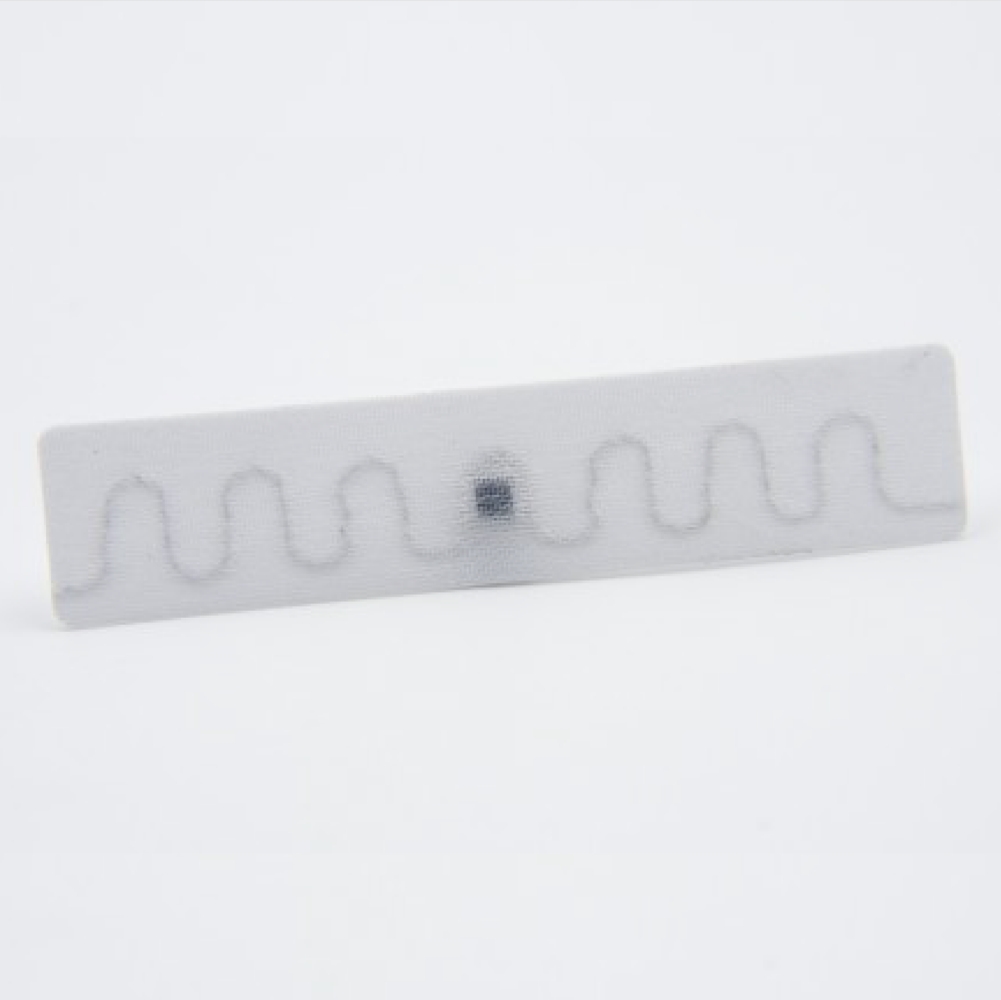
Is your hotel constantly losing towels, sheets, and robes? Are your staff spending hours counting linen instead of helping guests? You're not alone. Linen loss is a multi-billion dollar problem for the hospitality industry. But what if you could turn invisible inventory into a smart, manageable asset?
The answer lies in RFID laundry tags, specifically rugged ones like our TT7015s. Here’s how they create a smarter, more profitable hotel operation:
Slash Inventory Shrinkage: With a unique ID on every item, you know exactly what you have and where it is. Suddenly, those "lost" pool towels magically reappear. This direct loss prevention can save thousands per year.
Eliminate Manual Counting: Imagine doing a full inventory of your laundry room in under a minute. With a handheld UHF RFID reader, your staff can scan an entire cart without moving a single sheet, freeing them for guest-facing tasks.
Extend Linen Lifespan: The TT7015s is built to last over 200 washes. By tracking wash cycles, you can retire items before they become threadbare and ruin your guest experience, optimizing your purchasing budget.
Streamline Laundry Workflow: Automate the sorting process. Clean items can be automatically sorted by type and destination (e.g., "Spa Towels," "King Bed Sheets"), drastically reducing labor costs and speeding up turnaround.
Data-Driven Decisions: How many times does a sheet typically get used before it's replaced? Now you have the data. Make smarter purchasing decisions, negotiate better with suppliers, and finally prove your ROI on linen spend.
Implementing RFID for hotel linen management isn't just about technology; it's about empowering your team, impressing your guests with flawless service, and protecting your bottom line. It’s a simple stitch that strengthens your entire operation.
The IOTE 2025 Expo in Shenzhen was a whirlwind of RFID and IoT innovation. While the exhibition halls buzzed with the latest hardware, the true pulse of strategic collaboration often beats in the conference rooms alongside such mega-events.
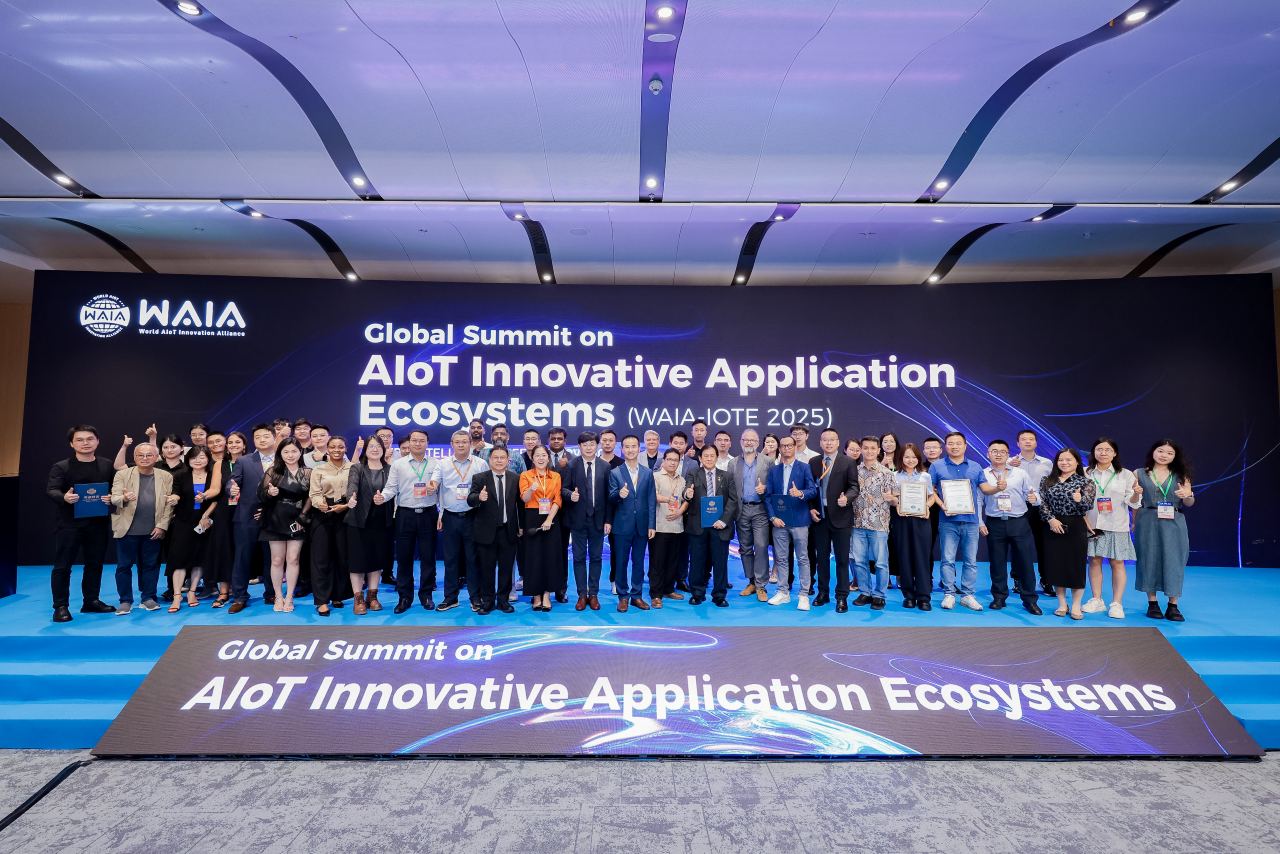
The WAIA (World AIoT Innovation Alliance) Summit on August 27th offered precisely this invaluable platform. Focusing on "Global AIoT Market Trends & Strategic Collaboration," the summit gathered international AIoT association leaders, operators, and researchers. The agenda was rich with insights into regional market trends, featured project releases, and best practice case studies crucial for anyone invested in the future of Intelligent Connectivity.
A key highlight was the panel discussion on "AIoT Innovation Across Regions & Industries," addressing pressing trends, challenges, and opportunities. The subsequent launch of the WAIA Global AIoT Expert Group and the signing of MoUs underscored a collective drive towards a more integrated global AIoT ecosystem.
For companies like ours, SeeMore IoT, which focuses on precision-engineered RFID hardware solutions for Industrial IoT, smart retail, and logistics, events like the WAIA Summit are indispensable. It’s where we move beyond mere transactions to form the strategic partnerships essential for navigating the complex landscape of digital transformation. The exclusive networking cocktail reception was particularly fruitful for connecting with fellow pioneers and discussing real-world applications of RFID in smart parking, asset tracking, and supply chain management.
Keywords: WAIA Summit 2025, AIoT ecosystem, global AIoT collaboration, IoT market trends, strategic partnerships in IoT, Industrial IoT solutions, intelligent connectivity, RFID hardware solutions, smart parking RFID, digital transformation partner
The recent integration of Impinj Gen2X technology into Avery Dennison’s RFID inlays is more than an upgrade—it’s a game-changer. For businesses struggling with inaccuracy, slow scans, or high-loss environments, this collaboration offers a breakthrough.
What’s New?
Gen2X enhances RFID tag performance in three key ways:
Speed: Scan thousands of items per second, even when stacked or hidden.
Accuracy: Achieve 99.9% read rates despite metal or liquid interference.
Cost-Efficiency: Smaller antenna designs lower tag costs, critical for high-volume applications.
Why It Matters for You
Retailers: Simplify self-checkout and reduce theft with reliable item-level tracking.
Logistics Managers: Track pallets or individual items in real time, eliminating manual errors.
Food Suppliers: Cut waste with expiry-date monitoring and dynamic pricing.
The Bottom Line
Avery Dennison’s move makes advanced RFID stickers accessible to all. Whether you’re in retail, logistics, or food services, now is the time to explore Gen2X-powered RFID solutions for a smarter, more connected operation.
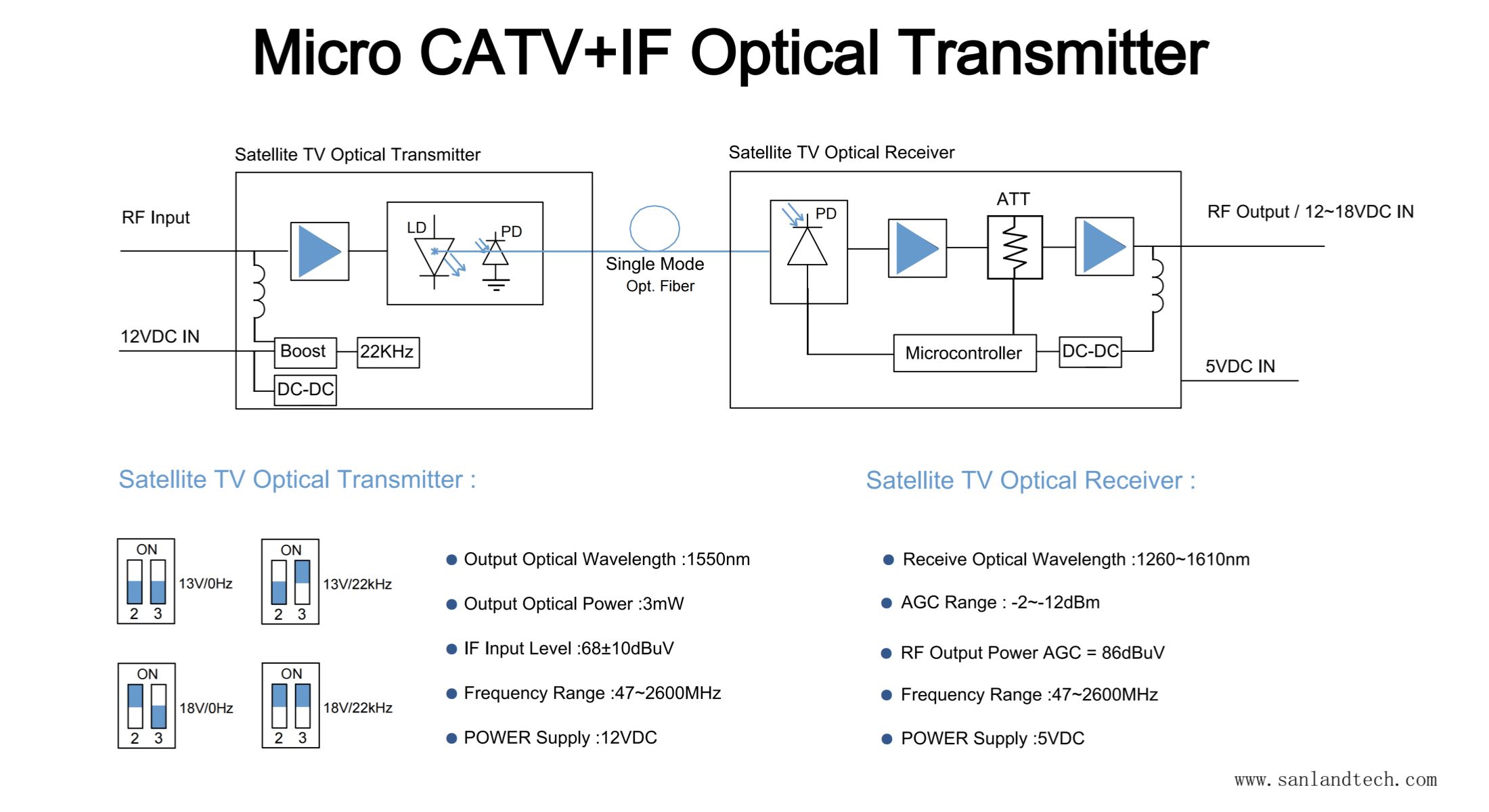
Fiber optic technology has become the backbone of today’s video and broadband distribution. When it comes to CATV and satellite TV networks, a CATV+IF optical transmitter and receiver system provides a powerful way to deliver high-quality signals over long distances, while keeping performance stable and deployment simple.
The Role of Optical Transmission in Modern Networks
Traditional coaxial cables face limitations in distance, bandwidth, and resistance to interference. By switching to fiber, operators and service providers gain:
Extended reach without significant signal loss.
Support for wide frequency ranges up to 2600 MHz.
Immunity to external noise and EMI, ensuring consistent quality.
Flexibility for integration in both FTTH and satellite TV environments.
This makes optical transmitter and receiver solutions essential in next-generation distribution systems.
Core Features of the Solution
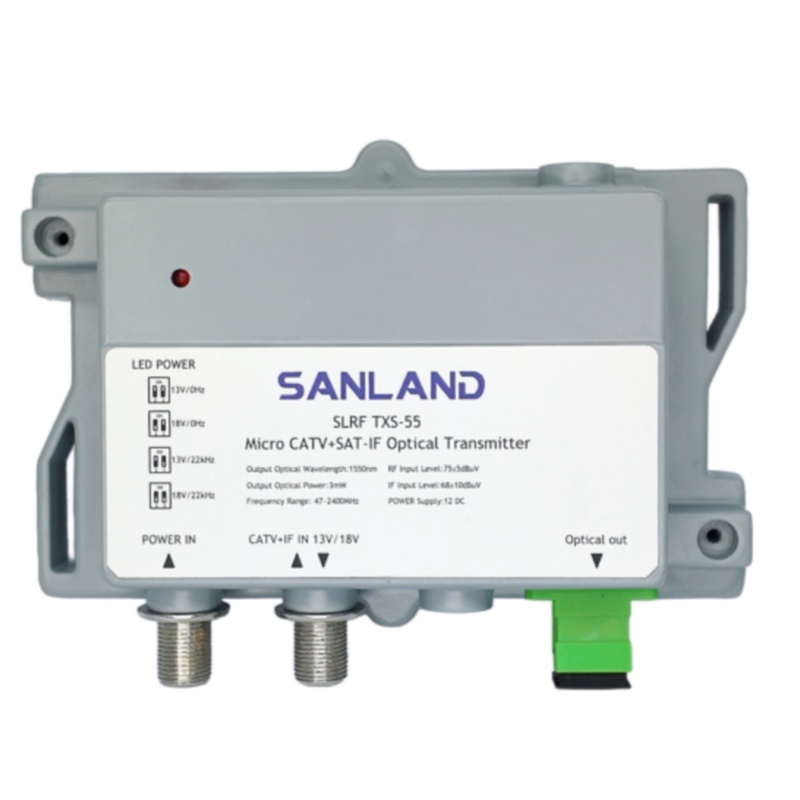
Optical Transmitter (1550 nm, 3 mW Output)
Delivers stable optical power for long-haul fiber transmission.
Supports 47–2600 MHz frequency range, ideal for CATV and satellite IF signals.
Compact and energy-efficient design, powered by 12VDC.
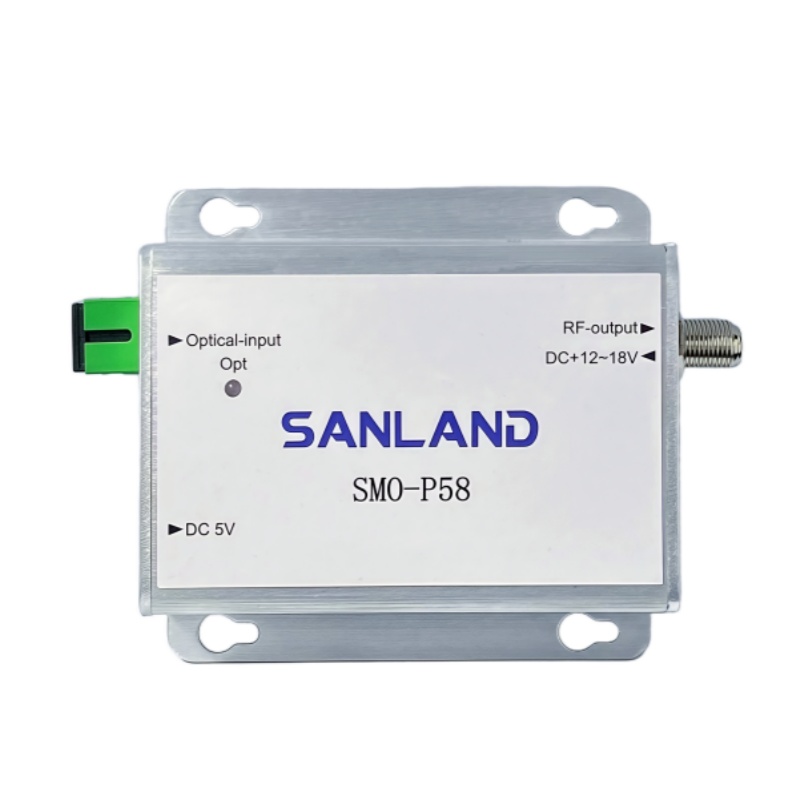
Optical Receiver with AGC
Covers 70–2600 MHz bandwidth with excellent flatness (±2 dB).
AGC function ensures constant RF output (84–88 dBµV), even when optical input fluctuates between -12 dBm and -2 dBm.
Maintains high CNR and MER, guaranteeing clear video and stable broadband performance.
Low power consumption, compact size, and user-friendly monitoring LED.
Application Scenarios
FTTH (Fiber to the Home)
Brings CATV and broadband services directly to subscribers.
Ensures end users enjoy strong, consistent signals with minimal maintenance.
Satellite TV Distribution
Transports satellite IF and CATV signals through a single fiber.
Compatible with 13/18V control and 22 kHz tone switching, widely used in satellite systems.
Mixed Service Networks
Integrates CATV, high-speed internet, and satellite broadcasting in one solution.
Simplifies network architecture while reducing operating costs.
Why Operators Choose CATV+IF Optical Solutions
Wideband performance: Supports existing and future services up to 2600 MHz.
Reliable output: AGC technology eliminates fluctuations caused by optical power variation.
Easy integration: Compact design and SC/APC connectors ensure simple deployment.
Future-ready investment: Flexible enough to adapt as networks expand.
Final Thoughts
For network operators, ISPs, and system integrators, a CATV+IF optical transmitter and receiver system is a proven solution for FTTH and satellite TV applications. By combining the strengths of fiber optics with smart features like AGC, it ensures high-quality service delivery, stable network performance, and a cost-effective path toward the future of broadband and broadcasting.
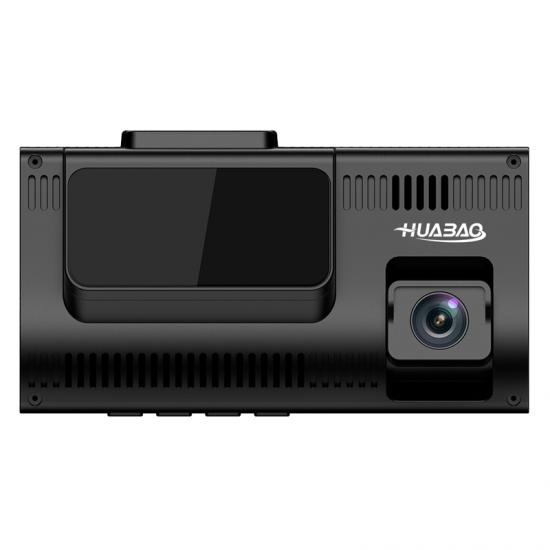
In the competitive world of commercial transportation, maintaining control over your fleet's performance is about more than just tracking locations and managing fuel costs. It's about gaining real visibility into daily operations—something that modern fleet managers can no longer afford to overlook. This is where Huabao Fleet Management steps in, offering intelligent vehicle camera systems designed specifically for the evolving needs of commercial fleet operators.
As logistics companies face growing pressure to improve safety, reduce operational risk, and meet compliance standards, onboard camera technology has become a cornerstone of effective fleet oversight. Huabao's integrated camera solutions go beyond simple recording—they deliver real-time insights that empower fleet supervisors to act decisively and proactively.
One of the most pressing issues in managing commercial vehicles is the uncertainty surrounding roadside incidents. Who was at fault? Was the driver following protocol? Without evidence, disputes can lead to inflated insurance claims and reputational damage. Huabao's vehicle cameras provide clear, reliable video documentation, serving as an impartial witness during accidents or traffic conflicts. This not only protects drivers from false accusations but also helps companies resolve claims faster and with greater confidence.
Driver behavior is another key area where visibility makes a difference. Harsh braking, distracted driving, or failure to follow safety procedures can all be identified and addressed through video-based monitoring. With Huabao's system, fleet managers can implement targeted coaching programs that foster safer driving habits, ultimately reducing accident rates and improving overall fleet safety.
For businesses operating delivery fleets, waste management vehicles, or regional transport services, accountability matters at every stop. Huabao's cameras support operational transparency by capturing critical moments such as cargo handling, customer interactions, and route deviations. This level of detail strengthens internal processes and enhances customer trust, especially in last-mile delivery environments where service quality directly impacts brand reputation.
What sets Huabao apart is its seamless integration with broader fleet management ecosystems. The camera system doesn't work in isolation—it complements telematics, GPS tracking, and maintenance alerts to create a unified view of fleet health and performance. Whether managing a small delivery fleet or a large-scale transport operation, this holistic approach enables smarter decision-making and improved operational efficiency.
As the industry moves toward greater automation and digital oversight, adopting advanced vehicle camera technology is no longer optional—it's essential. Huabao is at the forefront of this shift, providing commercial fleet operators with the tools they need to stay safe, compliant, and competitive.
In today's demanding transportation landscape, true fleet visibility means seeing more than just a dot on a map. It means understanding what's happening inside and around each vehicle, in real time. With Huabao Fleet Management, that level of insight is now within reach.
Why 4G GPS tracker lock matters for fleets in 2025
Cargo theft keeps rising, with incidents increasing by more than 59% in just one year and more than $39 million lost to stolen freight in recent months. As a vehicle owner, you face risks from both physical and cyber threats. Criminals target vehicles at unsecured stops, use technology to hack tracking systems, and exploit weak security. Older tracking devices cannot keep up with these threats. By choosing a 4g gps tracker lock, you boost your fleet’s protection and monitoring. The latest 4g gps tracker solutions, including GPS Electronic Locks and Electronic Locks, help vehicle owners prevent theft and misuse. Strong adoption rates prove that advanced 4g gps tracker locks are now essential for every vehicle owner seeking a reliable solution.
Key Takeaways
***4G GPS tracker locks provide real-time tracking and instant alerts to protect fleets from theft and unauthorized access. ***Advanced features like geofencing, illegal unlock alarms, and chain cut alerts help prevent cargo loss and improve vehicle security. ***Real-time monitoring and automated reports boost fleet efficiency by reducing fuel waste, improving driver behavior, and streamlining operations. ***Accurate, automated data supports compliance with regulations and simplifies audits, saving time and avoiding fines. ***Using 4G GPS tracker locks lowers insurance costs and prepares fleets for future technology with scalable, flexible solutions.
Security
4G GPS Tracker Lock Protection
You face new risks every day as a vehicle owner. In 2025, theft remains a major threat to your fleet. Criminals use advanced tactics to steal vehicles, break into cargo, and even hack telematics systems. You need a 4g gps tracker lock to stay ahead. This anti theft solution gives you real-time location tracking, so you always know where your vehicle is. With a 4g gps tracker, you get instant alerts if someone tries to tamper with your cargo or unlock a door without permission. The HB-A1Lm gps anti theft device uses 4G LTE networks for reliable coverage, even in remote areas. You can rely on its long battery life and rugged design for continuous protection.
Fleet vehicles now face cyberattacks that target telematics, risking control hijacking and data breaches. A 4g gps tracker lock helps you fight back. It switches to aggressive reporting if theft occurs, helping law enforcement recover your assets. You can trust this anti theft device to protect your investment and keep your business running.
Preventing Unauthorized Access
You want to stop theft before it happens. The best anti theft devices do more than just track your vehicle. The HB-A1Lm gps anti theft device offers enhanced security features like illegal unlock alarms, chain cut alerts, and geofencing. These tools work together to keep your fleet safe:
***Geofencing monitors your vehicle’s route and alerts you if it leaves a safe area. ***Illegal unlock alarms warn you if someone tries to open a door without approval. ***Chain cut alerts detect any attempt to break physical locks.
These anti theft solutions give you full control over who can access your vehicle and when. You can set up remote locking, so only authorized users can open cargo doors at approved locations. With these vehicle protection solutions, you reduce the risk of vehicle theft and cargo loss. You protect your reputation and save money by preventing theft before it happens.
Real-Time Tracking
Tracking Device for Vehicles
You need to know where every vehicle in your fleet is at all times. A modern tracking device gives you this power. With real-time tracking, you see each vehicle’s location, speed, and route instantly. This level of visibility helps you prevent misuse and keep your assets safe. You can monitor driver behavior, spot unsafe actions, and respond right away. When you use a tracking device, you get instant notifications if a vehicle leaves its route or stops unexpectedly. This keeps your operations smooth and secure.
A tracking device like the HB-A1Lm 4G Gps Tracker Electronic Lock supports multiple vehicles at once. You can manage your entire fleet from one dashboard. Real-time tracking lets you verify mileage, check delivery progress, and make quick decisions. You reduce downtime and improve productivity. You also cut costs by optimizing routes and reducing fuel use. With a tracking device, you gain control over every vehicle and every trip.
Route and Geofence Alerts
Route and geofence alerts give you even more control over your fleet. You set virtual boundaries for each vehicle. If a vehicle enters or leaves a zone, you get an alert right away. This stops unauthorized use and helps you recover stolen vehicles faster. Route deviation notifications tell you when a vehicle strays from its planned path. You can act quickly to fix problems and keep deliveries on time.
***Geofencing prevents unauthorized vehicle use and theft.
***Route alerts help you enforce compliance and reduce fuel waste.
***Real-time alerts improve accountability and transparency.
***Monitoring route deviations cuts down on mileage fraud and fuel theft.
With these features, your tracking device becomes a powerful tool for security and efficiency. You keep every vehicle on track and every delivery on schedule.
Efficiency
Streamlined Operations
You want your fleet to run like a well-oiled machine. A 4g gps tracker lock helps you achieve this by removing the need for manual checks and endless paperwork. With real-time tracking, you always know where each vehicle is and how it performs. You can monitor driver behavior, vehicle diagnostics, and route progress from your dashboard. This level of control means you spend less time chasing down vehicles and more time growing your business.
***4G/LTE technology gives you faster, more reliable connectivity for every vehicle. ***Real-time monitoring lets you check vehicle locations, driver actions, and diagnostics without leaving your office. ***Automated alerts and trip logs keep you informed about every vehicle’s status. ***Idle reporting and diagnostics help you reduce fuel waste and prevent breakdowns. ***Remote security tools, like kill switches and door locks, stop unauthorized vehicle use instantly.
The HB-A1Lm stands out with its long battery life, lasting up to 28 days, so you never worry about losing connection during long trips. Its modular design lets you add sensors for temperature, humidity, or fuel, giving you even more insight into each vehicle’s condition. You can connect multiple locks to one main unit, making it perfect for multi-door vehicles or complex fleets.
Automated Reporting
Automated reporting changes the way you manage your fleet. You get instant updates on every vehicle, from location to driver behavior. These reports help you spot problems before they grow. You can track risky driving, fuel use, and maintenance needs with just a few clicks. This data-driven approach leads to safer driving, lower costs, and better customer service.
***Real-time tracking provides continuous updates for every vehicle. ***Automated maintenance alerts help you schedule repairs before breakdowns happen. ***Fuel analytics show you where to cut costs and improve efficiency. ***Custom dashboards let you see the data that matters most for your fleet. ***Predictive maintenance and driver scorecards help you coach drivers and prevent accidents.
With the HB-A1Lm, you gain access to a unified dashboard that brings together tracking, telematics, and video. You can generate custom reports, monitor driver habits, and optimize routes for every vehicle. Automated reporting gives you the power to make smart, fast decisions that keep your fleet ahead of the competition.
Compliance
Accurate Data
You need accurate data to keep your fleet compliant and ready for any audit. A 4g gps tracker lock gives you real-time information about every vehicle. You can see where your trucks are, how long they stop, and when they move. This data is always up to date and easy to access. You do not have to worry about missing logs or paperwork errors. The system records everything automatically, so you can focus on running your business.
***Automated driver logs make your records tamper-proof. ***Real-time tracking shows vehicle locations and routes. ***Maintenance and inspection data appear instantly on your dashboard. ***Digital records help you pass audits and inspections with confidence.
Regulatory Support
You face strict rules in fleet management. Meeting these requirements can feel overwhelming. A 4g gps tracker lock helps you stay ahead. The system supports federal mandates like the FMCSA ELD rule by recording hours of service and vehicle movement. You get alerts if a driver nears a violation, so you can act fast and avoid penalties.
***The HB-A1Lm works in customs inspection and government fleets.
***It locks cargo and only opens in approved zones, meeting customs protocols.
***The device stands up to harsh conditions with its waterproof and explosion-proof design.
***You can tailor settings for different countries and regulations.
You gain peace of mind knowing your fleet meets every rule. You simplify roadside inspections and keep your data secure. With the right technology, you turn compliance from a burden into a business advantage.
Cost Savings
Asset Utilization
You want every vehicle in your fleet to work harder for your business. A 4g gps tracker lock gives you the power to monitor each vehicle and prevent theft. When you know where your vehicles are, you stop unauthorized use and keep your assets safe. You see which vehicles sit idle and which ones move, so you can make better decisions. This solution helps you use every vehicle more efficiently.
GPS tracking lets you set geofences and receive alerts if a vehicle leaves its route. You act fast to stop theft or misuse. A refrigerated rental company in Texas uses GPS tracker locks to prevent unauthorized interstate use. Their manager reports fewer losses and better control. You get proof of misuse, which helps you recover vehicles and avoid costly mistakes.
A study by the National Insurance Crime Bureau shows that areas with GPS tracking see lower vehicle theft rates. You save money by reducing recovery costs and keeping your vehicles on the road. Fleet GPS tracking also encourages safer driving and better maintenance. You spend less on repairs and fuel. Every vehicle works for you, not against you.
Lower Insurance
Insurance companies want to see strong security in your fleet. When you install a 4g gps tracker lock, you show insurers that you take theft prevention seriously. Real-time location data helps insurers assess risk more accurately. They know your vehicles have protection against theft and misuse.
***GPS trackers reduce theft and unauthorized use, lowering risk for insurers.
***Real-time data speeds up claims and reduces fraud.
***Insurers offer discounts or lower premiums for vehicles with GPS tracker locks.
Experts confirm that GPS tracker locks help insurers handle claims faster and set better rates. You get up to 30% off your insurance premiums when you use GPS tracking. You save money every year. You also gain peace of mind knowing your vehicles have the best protection.
Future-Proofing
4G GPS Tracker Integration
You want your fleet to stay ahead as technology changes. Adopting a 4g gps tracker lock prepares your business for the future. This technology gives you faster data transfer, real-time tracking, and accurate vehicle locations. You can monitor your fleet every minute, which improves security and keeps your operations running smoothly.
***4G GPS trackers work with many types of vehicles, from trailers to box trucks.
***You install these devices quickly, so your fleet spends less time off the road.
***User-friendly software lets you manage your fleet from your computer or phone.
***You get technical support that helps you solve problems fast.
The HB-A1Lm stands out because it connects with PC software, mobile apps, and Bluetooth accessories. You can add sensors for temperature, fuel, or even more locks as your needs grow. This flexibility means your fleet can handle new challenges and take advantage of new tools as they appear.
Scalable Solutions
You need solutions that grow with your business. The HB-A1Lm gives you a modular design, so you can add more locks or sensors as your fleet expands. You can connect up to seven slave locks to one main unit, making it perfect for multi-door vehicles or larger fleets.
Fleet management is changing quickly. AI and IoT are making fleets smarter, safer, and more efficient. Real-time route optimization, predictive maintenance, and digital twins are becoming standard. Companies that use these tools see fewer breakdowns, lower costs, and better safety. Electric vehicles and green strategies are also on the rise, helping you save money and meet new regulations.
***AI automates decisions and improves safety.
***IoT sensors track vehicles and predict problems before they happen.
***Digital twins let you model your fleet in real time for better planning.
You can trust that a 4g gps tracker lock will keep your fleet ready for whatever comes next. You stay competitive, reduce risks, and make your business future-proof.
A Comprehensive Guide to RF-60TC: Is It the Superior High-Frequency PCB Substrate for Your Project?
In the rapidly advancing world of wireless technology, the demand for high-performance, reliable printed circuit boards (PCBs) is greater than ever. For engineers and designers working on cutting-edge RF and microwave systems, selecting the right substrate material is a critical decision that directly impacts product performance, efficiency, and longevity. Enter the RF-60TC High Frequency PCB, a premier PTFE-based, ceramic-reinforced composite material engineered to excel in the most demanding high-power applications. This blog delves into the superior properties, extensive manufacturing capabilities, and diverse applications of this exceptional material.
Unveiling the RF-60TC: A Material Engineered for Excellence
The Taconic RF-60TC is not just another PCB substrate; it represents a significant leap forward in material science. Crafted from a polytetrafluoroethylene (PTFE) base infused with ceramic and woven fiberglass, it is specifically formulated to address the unique challenges of high-frequency circuits. A key differentiator is its ability to maintain operational stability at elevated power levels while generating lower operating temperatures. This characteristic is paramount for enhancing power gains and boosting overall system efficiency, particularly in the increasingly prevalent miniaturized antenna systems operating within a controlled dielectric constant (Dk) of 6.15. These advantages are primarily derived from the material's superior dielectric heat dissipation properties and its exceptionally low signal loss, ensuring pristine performance.
A Deep Dive into the Defining Features of RF-60TC
The exceptionalism of the RF-60TC material is underscored by its robust set of technical attributes:
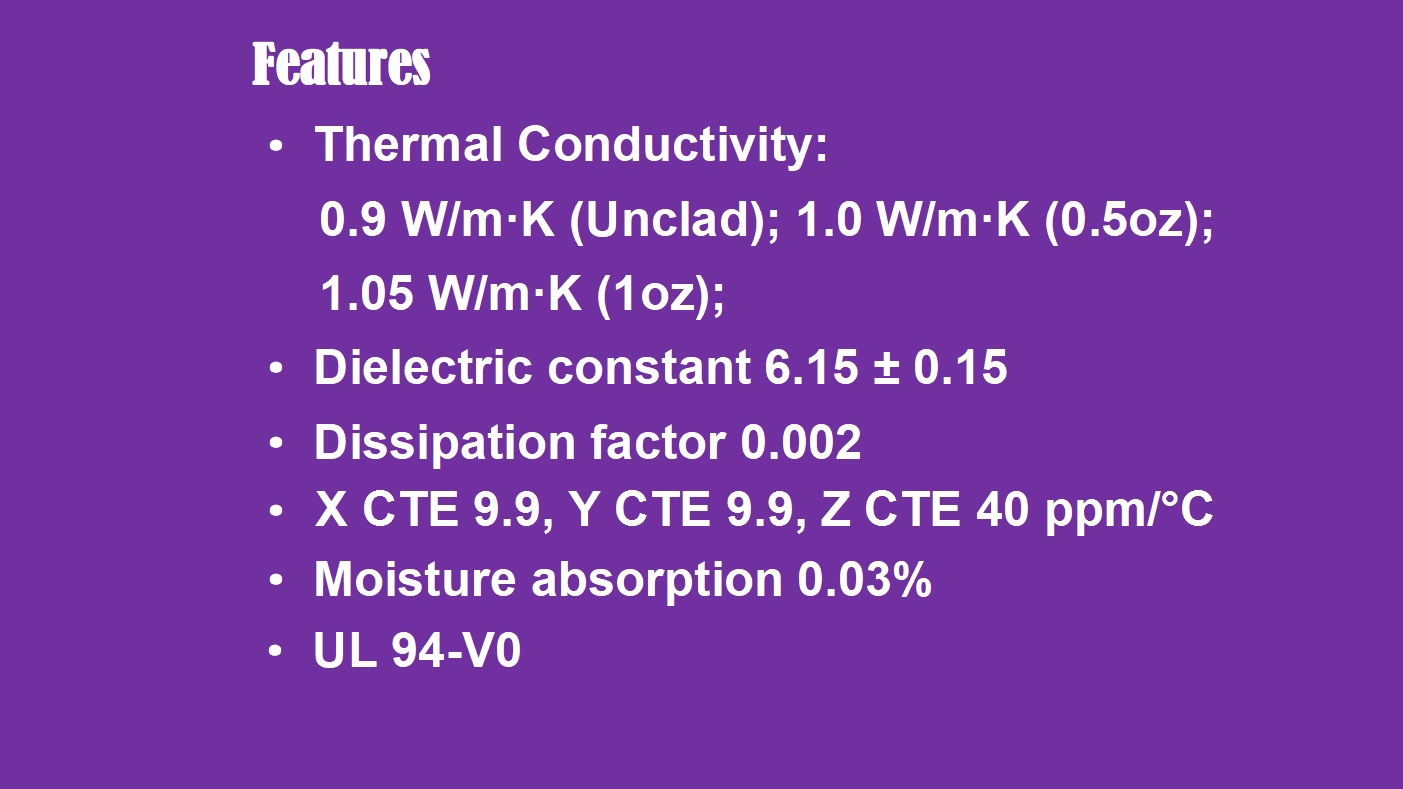
1) Superior Thermal Conductivity: A standout feature is its impressive thermal management capability. The substrate offers thermal conductivity values of 0.9 W/m·K for unclad laminates, which increases to 1.00 W/m·K for 0.5oz copper cladding and 1.05 W/m·K for 1oz cladding. This efficient heat dissipation reduces thermal stress on active components, thereby extending their operational lifespan and guaranteeing long-term reliability for your designs.
2) Stable Dielectric Constant: With a consistent dielectric constant (Dk) of 6.15±0.15 measured at 10 GHz, the RF-60TC provides exceptional electrical predictability. This stability is crucial for impedance control and is a fundamental enabler of device miniaturization, allowing designers to optimize board space without sacrificing electrical performance.
3) Minimal Dissipation Factor: The material exhibits an extremely low dissipation factor (Df) of just 0.002 at 10 GHz (as per IPC-650 2.5.5.5.1). This low loss tangent translates to highly efficient signal transmission, minimizing energy loss and preserving signal strength in sensitive RF applications.
4) Enhanced Dimensional Stability: The RF-60TC features a low coefficient of thermal expansion (CTE), with values of 9.9 ppm/°C in the X and Y axes and 40 ppm/°C in the Z-axis. This enhanced dimensional stability is vital for constructing complex, high-layer-count multilayer PCBs, as it ensures improved reliability of plated through holes (PTHs) across a wide temperature range.
5) Low Moisture Absorption: In harsh environmental conditions, moisture uptake can compromise a PCB's integrity. The RF-60TC boasts a remarkably low moisture absorption rate of 0.03% (IPC-650 2.6.2.1), ensuring consistent performance and unwavering environmental stability.
6) High Flammability Rating: Safety is never compromised. The material meets the stringent UL 94 V-0 flammability standard, confirming its self-extinguishing properties and high resistance to ignition.
Our Advanced PCB Manufacturing Capabilities with RF-60TC
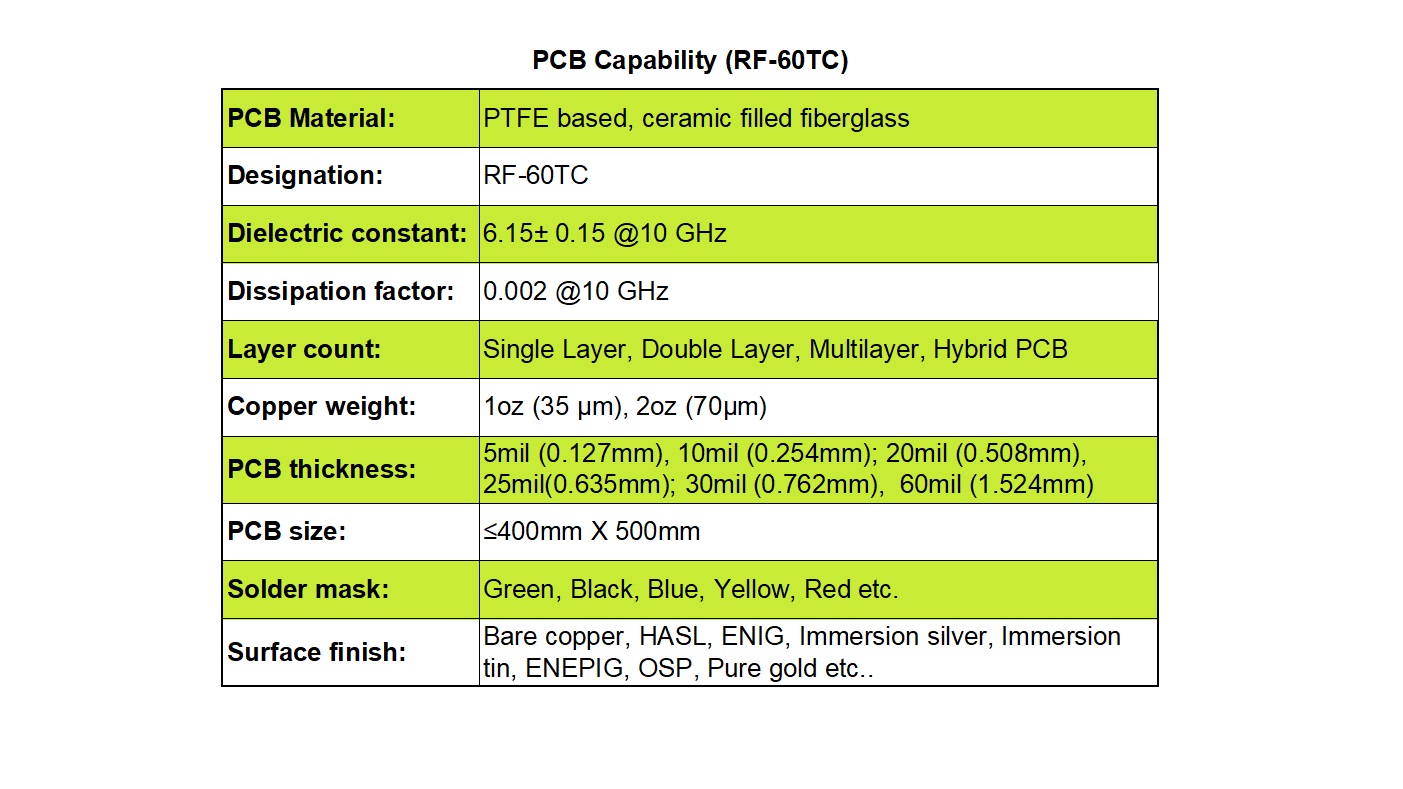
Leveraging this advanced material requires a manufacturing partner with precise technical expertise. We offer comprehensive fabrication services tailored to fully exploit the potential of RF-60TC Taconic High Frequency PCB:
Layer Count Versatility: We expertly manufacture everything from simple Single and Double Layer boards to sophisticated Multilayer and Hybrid multilayer constructions, combining different materials for optimal performance.
Flexible Copper Weight: To meet specific current-carrying and conductivity needs, we provide standard options of 1oz (35 µm) and 2oz (70µm) copper cladding.
Precision Thickness Control: We offer a wide spectrum of substrate thicknesses, including 5mil (0.127mm), 10mil (0.254mm), 20mil (0.508mm), 25mil (0.635mm), 30mil (0.762mm), and 60mil (1.524mm), granting unparalleled design flexibility.
Large Format PCBs: Our production facilities can handle substantial board sizes, accommodating panels up to 400mm x 500mm.
Custom Solder Mask: Aesthetic and functional choices are available with solder mask colors including Green, Black, Blue, Yellow, Red, and others.
Diverse Surface Finishes: To ensure solderability, durability, and performance, we provide a full suite of surface finishes: Bare copper, HASL, ENIG, Immersion Silver, Immersion Tin, ENEPIG, OSP, and Pure Gold.
Key Applications Driving Innovation
The unique property set of RF-60TC Taconic RF PCB makes them the substrate of choice for a broad spectrum of high-performance applications, including:
High-Power Amplifiers
Miniaturized Antennas for GPS, Patch, and RFID Reader Systems
Precision Filters, Couplers, and Power Dividers
Satellite Communication Technologies
Conclusion
The RF-60TC Taconic PCB material stands as a testament to innovation, offering an unparalleled combination of thermal management, electrical performance, and mechanical reliability. By choosing this advanced substrate and partnering with a capable manufacturer, you empower your designs to achieve new heights of efficiency and power in the competitive realm of RF and microwave electronics.
What Makes Rogers AD250C PCB the Ideal Choice for High-Frequency Antenna Applications?
In the rapidly evolving world of wireless communication, the demand for high-performance, reliable antenna systems continues to grow. Rogers Corporation’s AD250C antenna laminates stand out as a premier specialty material engineered to address the exacting requirements of modern RF and microwave antenna markets. These advanced laminates are constructed from PTFE-based substrates reinforced with woven glass, resulting in superior high-frequency performance, exceptional passive intermodulation (PIM) characteristics, and outstanding processability for printed circuit board fabrication.
One of the most significant advantages of Rogers AD250C material is its composition. The glass-reinforced polytetrafluoroethylene (PTFE) structure ensures a tightly controlled dielectric constant while delivering remarkably low signal loss. This makes it an excellent foundation for antenna systems where signal integrity is paramount. Furthermore, the material is available with either standard electrodeposited copper foil or reverse-treated ED copper, providing designers the flexibility to optimize circuit efficiency and minimize passive intermodulation, a critical factor in multi-frequency and high-power environments.
Key Features of AD250C Antenna Laminates:
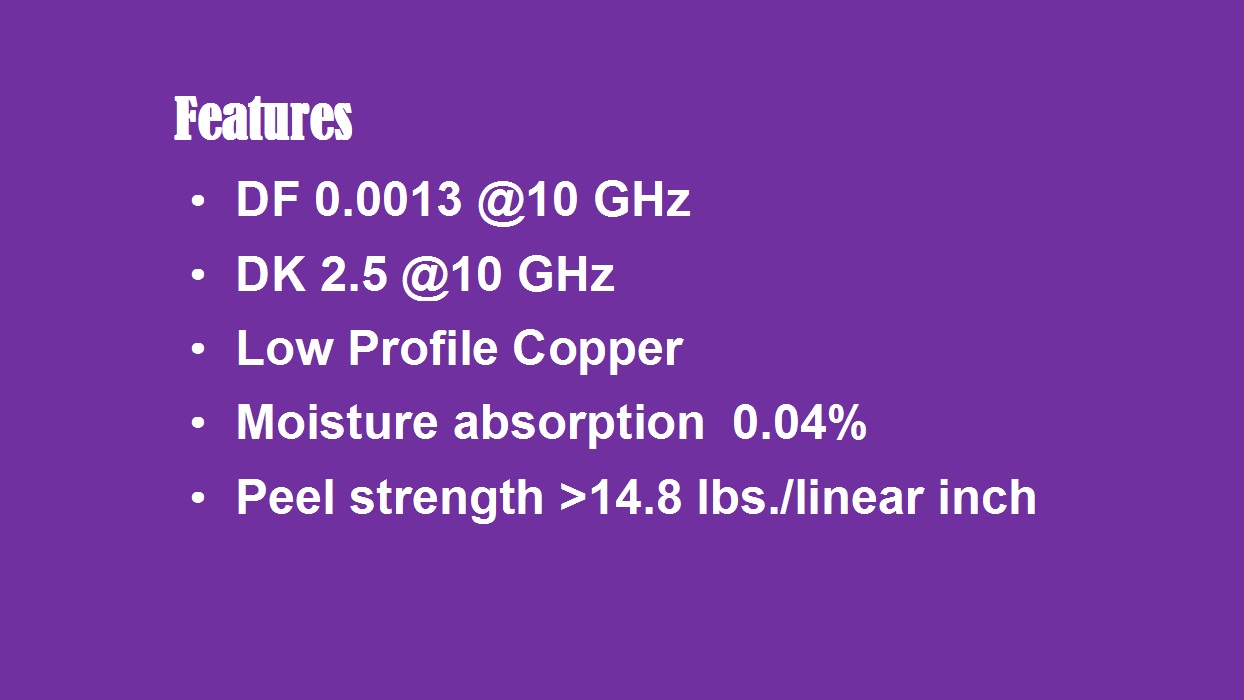
Extremely low dissipation factor of 0.0013 at 10 GHz, ideal for base station and other high-frequency applications, ensuring minimal signal loss and enhanced efficiency.
Consistent dielectric constant (Dk) of 2.50 with a narrow tolerance of±0.04, allowing accurate impedance matching and reliable signal propagation.
Low-profile copper foil options significantly reduce conductor losses, contributing to improved overall antenna gain and performance.
Moisture absorption as low as 0.04% guarantees stable operation under varying environmental conditions, maintaining electrical properties and prolonging service life.
Exceptional copper peel strength reaching 14.8 lbs per inch ensures robust mechanical adhesion between copper layers and substrate, enhancing durability in demanding applications.
PCB Fabrication Capabilities with AD250C:
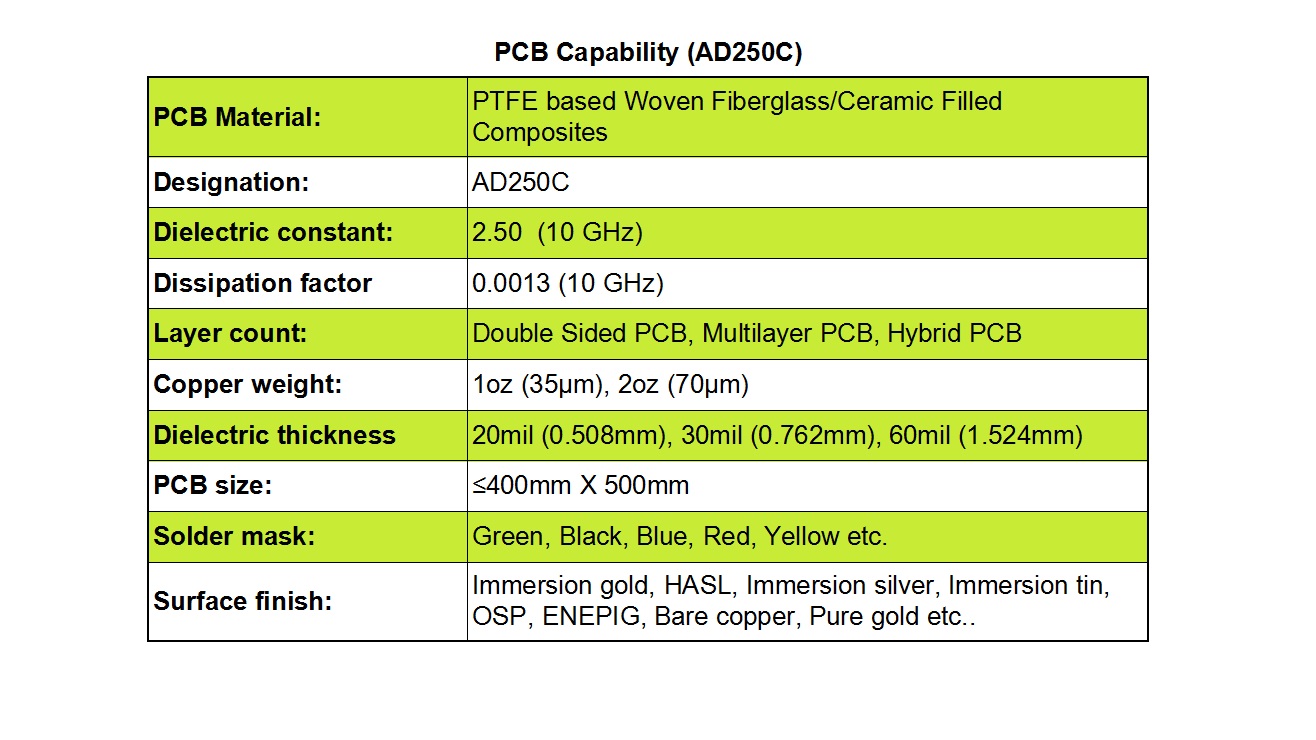
Our manufacturing services fully support AD250C substrates with a comprehensive suite of PCB solutions. We provide single-layer, double-layer, and multi-layer board configurations, as well as hybrid builds combining different materials. Standard thickness offerings include 20 mil, 30 mil, and 60 mil, with flexibility to accommodate custom requirements. Finished copper weights of 1oz and 2oz are available for traces and pads, balancing current carrying capacity and fine-line patterning.
We can produce large-format PCBs up to 400mm x 500mm, facilitating both individual large antennas and multi-design panelization for cost-effective production. A variety of solder mask colors—including green, black, blue, red, and yellow—are offered for aesthetic and functional preferences. We also support multiple surface finishes such as immersion gold (ENIG), hot air solder leveling (HASL), immersion silver, immersion tin, OSP, ENEPIG, as well as bare copper or selective gold plating.
Application Areas:
AD250C high frequency PCBs are widely used in critical communication infrastructure, including cellular base station antennas, automotive telematics and vehicle-to-everything (V2X) antenna systems, commercial satellite radio antennas, and other high-frequency wireless applications where low loss, high reliability, and consistent performance are essential.
Whether you are developing next-generation 5G infrastructure, advanced automotive radar, or satellite communication equipment, AD250C Rogers PCB provide the electrical and mechanical properties needed to achieve superior performance. Partner with us for your PCB manufacturing needs and leverage our expertise in high-frequency materials to bring your most challenging designs to life.
What Makes TMM13i High Frequency PCBs Ideal for Demanding RF and Microwave Applications?
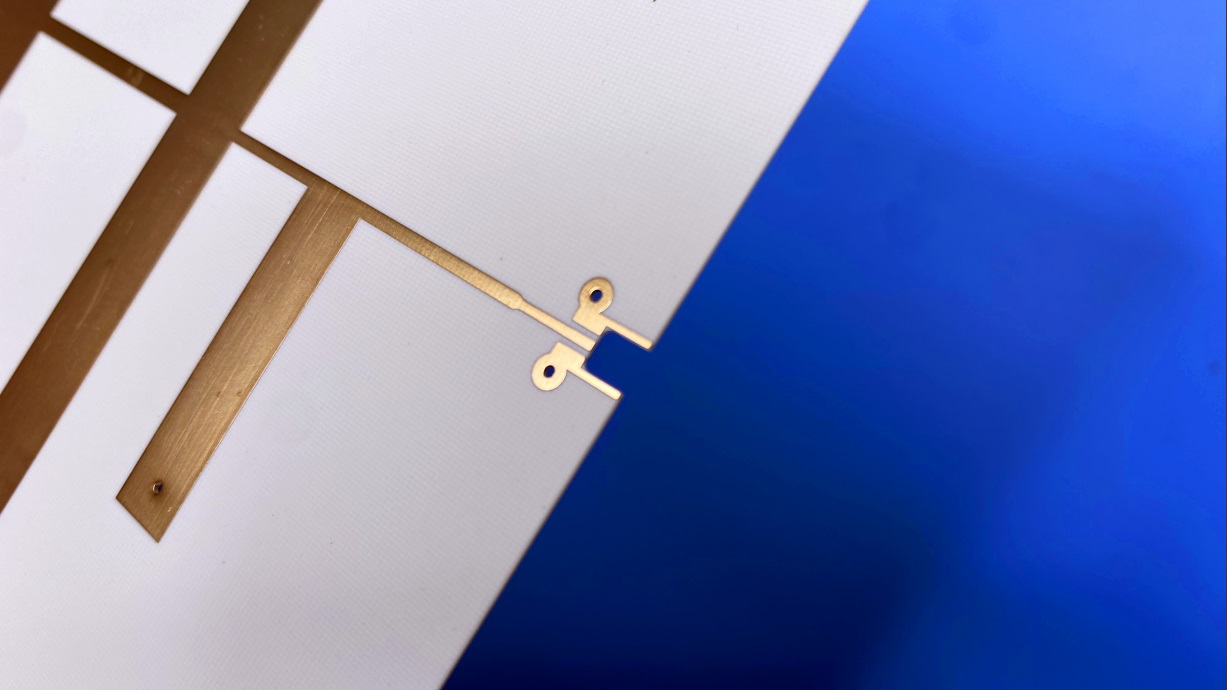
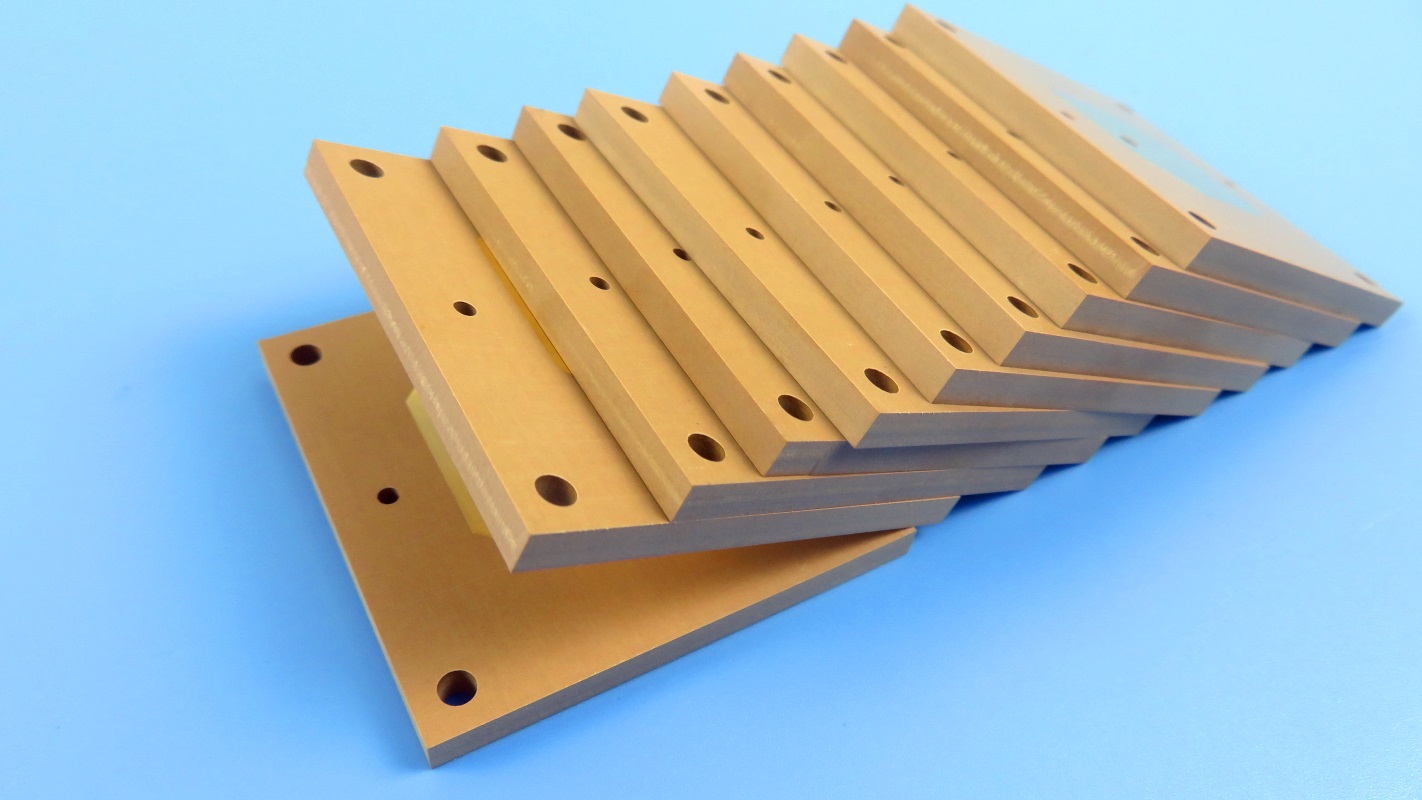
In the world of high-frequency electronics, the choice of printed circuit board (PCB) material is critical to achieving optimal performance and reliability. Rogers Corporation’s TMM13i isotropic thermoset microwave material stands out as an exceptional choice for high-frequency applications. This ceramic thermoset polymer composite is specifically engineered to deliver high reliability in plated through-hole strip-line and micro-strip configurations. By combining the beneficial properties of both ceramic and PTFE substrates, Rogers TMM13i allows designers to leverage the processing ease of soft substrate materials without compromising on electrical or thermal performance.
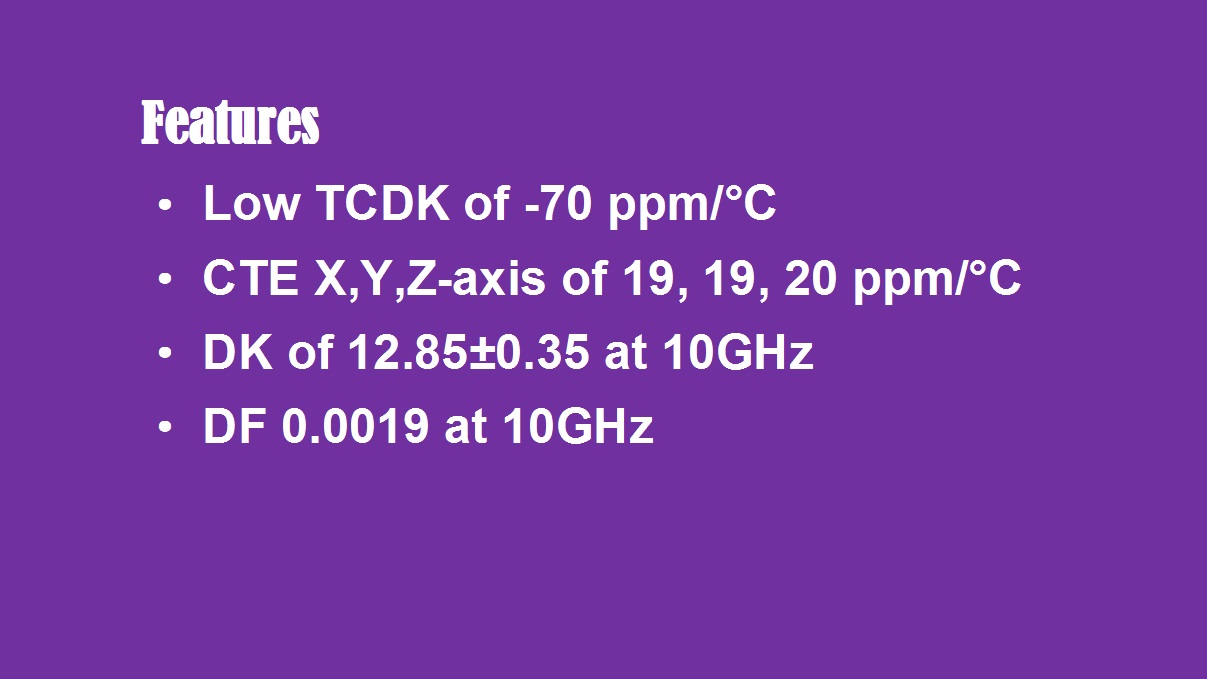
One of the key features of TMM13i laminate is their exceptionally low thermal coefficient of dielectric constant, rated at -70 ppm/°C. This ensures remarkable stability of the dielectric constant across a broad temperature spectrum, making it an excellent candidate for applications subject to significant temperature variations. Such thermal stability is essential in environments where performance consistency cannot be compromised.
Moreover, TMM13i PCB exhibits isotropic coefficients of thermal expansion (CTE)—19 ppm/°C in the X and Y axes, and 20 ppm/°C in the Z direction. These values are closely matched to those of copper, which significantly enhances the reliability of plated through holes and reduces etch shrinkage. This CTE matching minimizes the risk of delamination or cracking under thermal stress, thereby extending the lifecycle of the assembled PCB.
Another advantage of TMM13i substrate is its high dielectric constant of 12.85±0.35. This property allows for considerable miniaturization of circuit components, supporting the trend toward more compact and integrated electronic devices. In addition, the material’s low dissipation factor of 0.0019 at 10 GHz ensures minimal signal loss and improved energy efficiency, which is particularly valuable in high-speed digital and RF microwave circuits.
Our PCB Manufacturing Capabilities with TMM13i Material
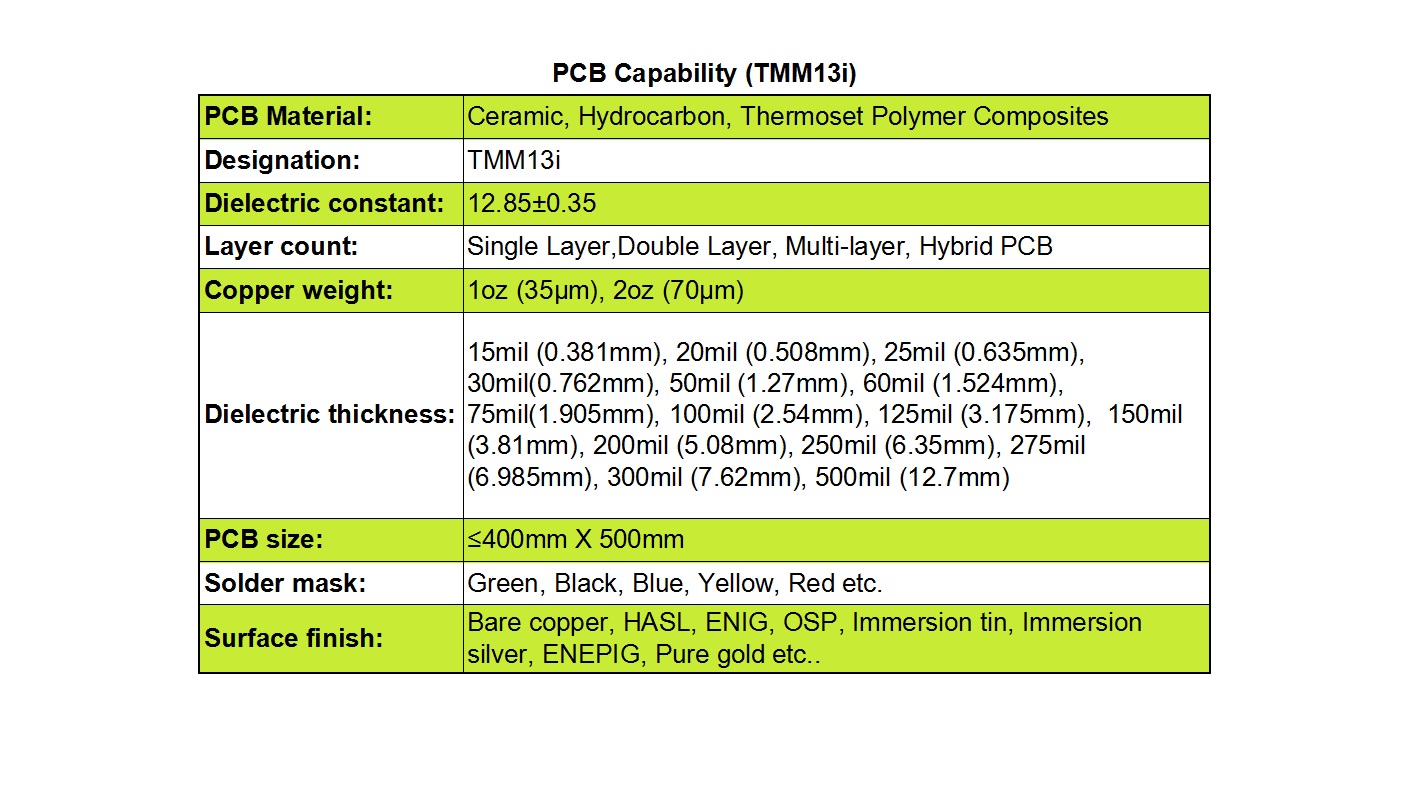
We take pride in offering advanced PCB fabrication services utilizing Rogers TMM13i high-frequency laminates. Our manufacturing facilities support a wide variety of PCB configurations—including single-layer, double-layer, multilayer, and hybrid boards—to meet diverse and customized project requirements.
We provide flexible copper weight options, including 1 oz (35 µm) and 2 oz (70 µm), to address specific conductivity and current-carrying needs. Our processes also support multiple dielectric thicknesses, from 15 mil (0.381 mm) up to 500 mil (12.7 mm), accommodating both standard and high-power designs.
For larger format designs, we can produce PCBs with dimensions up to 400 mm x 500 mm. Additionally, we offer a variety of solder mask colors—such as green, black, blue, yellow, and red—enabling alignment with your aesthetic branding or functional identification requirements.
To ensure superior performance and longevity, we provide a comprehensive selection of surface finishes: bare copper, HASL (Hot Air Solder Leveling), ENIG (Electroless Nickel Immersion Gold), OSP (Organic Solderability Preservative), immersion tin, immersion silver, ENEPIG (Electroless Nickel Electroless Palladium Immersion Gold), and pure gold.
Applications of TMM13i High Frequency PCBs
TMM13i-based PCBs are ideally suited for a broad range of high-performance applications. These include chip testers, dielectric polarizers, lenses, filters, couplers, and various RF and microwave circuits. Their excellent electrical properties also make them a preferred material in satellite communication systems, where signal integrity and thermal stability are paramount.
Whether you are designing advanced aerospace systems, telecommunications infrastructure, or sophisticated test and measurement equipment,TMM13i High Frequency PCBs provide the reliability and performance needed to succeed in demanding environments.
Why is TLX-9 the Preferred High-Frequency Laminate for Demanding Aerospace and Telecom Systems?
In the rapidly advancing world of high-frequency electronics, the choice of printed circuit board (PCB) material is critical to the performance, reliability, and efficiency of the end product. Taconic’s TLX-9 high-frequency PCB material stands at the forefront of this innovation, offering an exceptional blend of electrical, mechanical, and thermal characteristics tailored for demanding applications. This article delves into the core attributes, capabilities, and uses of TLX-9, illustrating why it is a top-tier choice for engineers and designers in industries where precision and performance are non-negotiable.
An Introduction to TLX-9 High Frequency Material
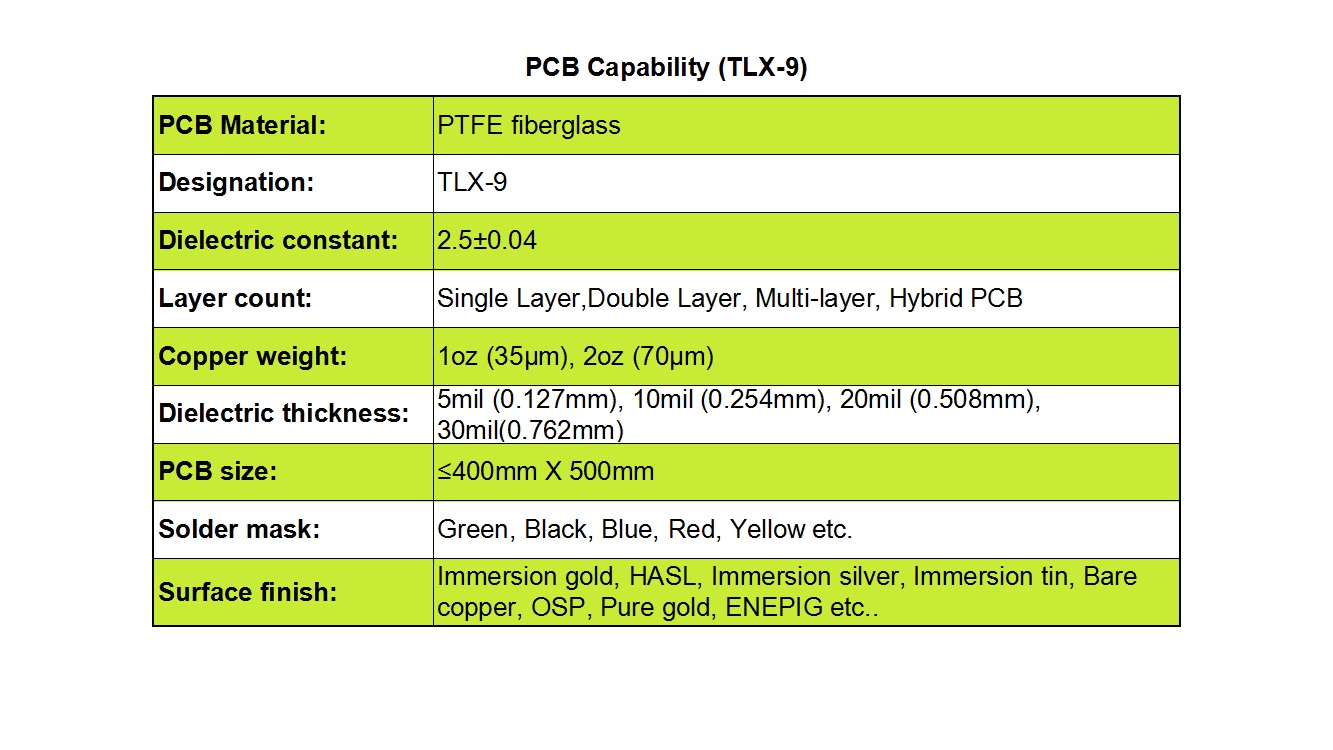
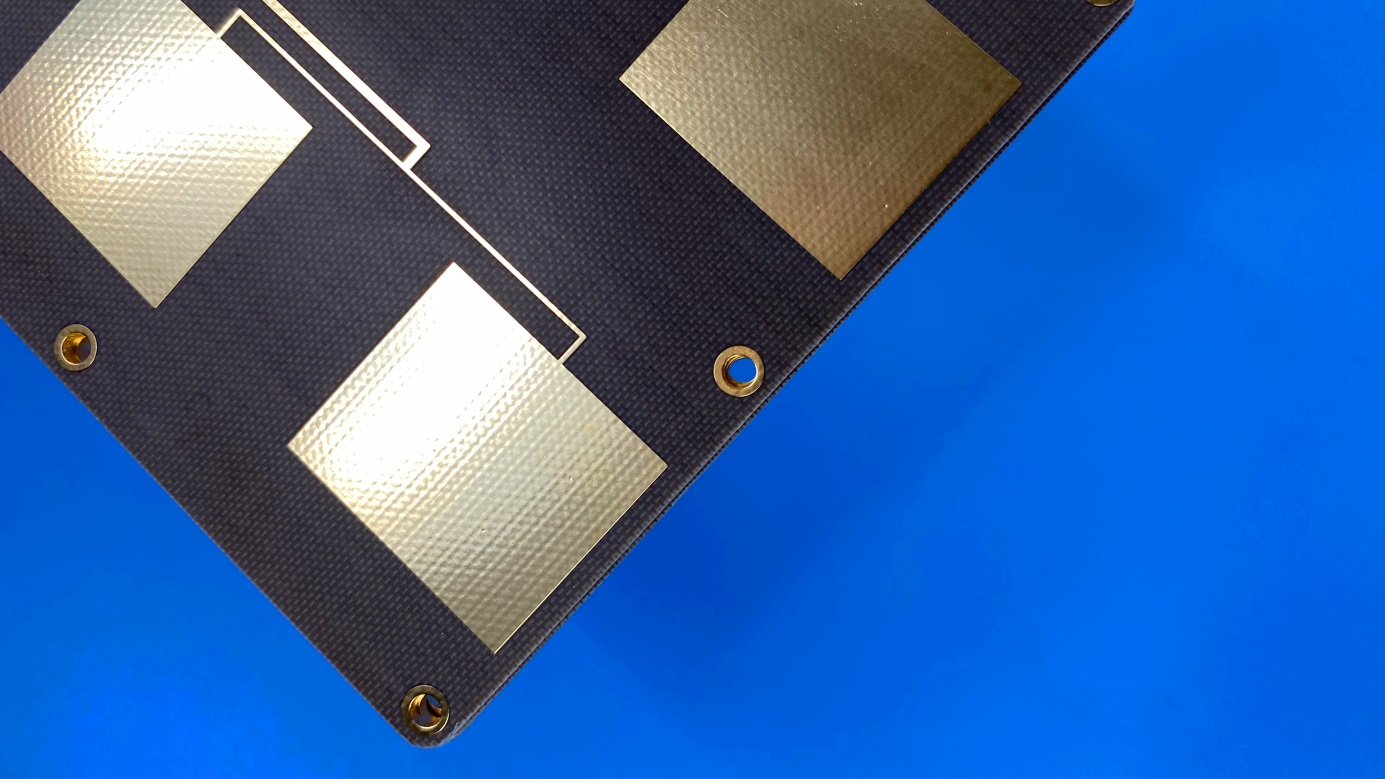
TLX-9 is a premium-gradehigh-frequency laminate constructed from a polytetrafluoroethylene (PTFE) base reinforced with woven fiberglass. This sophisticated composite represents a significant achievement in copper-clad PTFE technology, merging outstanding high-frequency electrical properties with excellent mechanical durability. It is manufactured under strict controls to ensure consistent performance, making it ideal for applications where signal integrity and operational stability are paramount.
Moreover, Taconic TLX-9 complies with the UL 94 V-0 flammability standard, enhancing its suitability for safety-sensitive environments. The material is also compatible with standard PCB fabrication processes—including shearing, drilling, milling, and plating—enabling straightforward integration into existing production workflows without the need for specialized equipment or techniques.
Key Features and Technical Specifications
The superior performance of TLX-9 PCB stems from its carefully engineered properties:
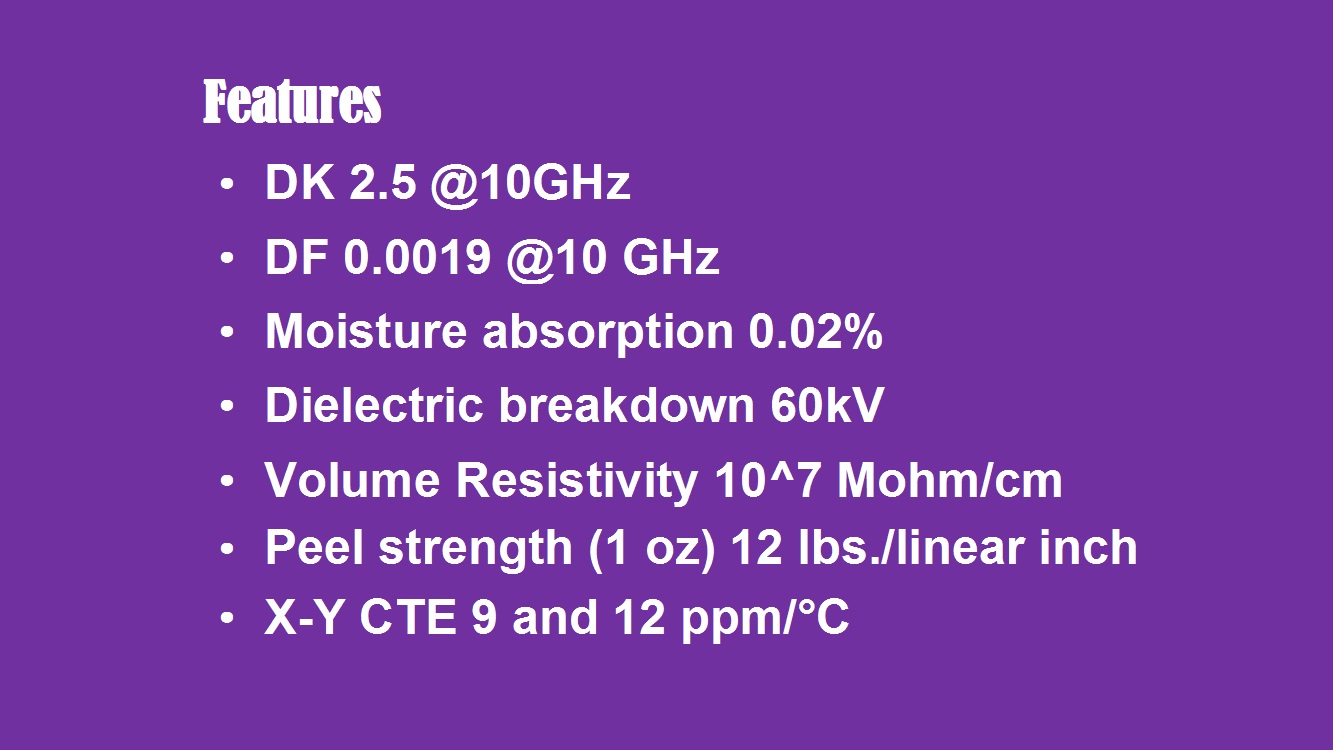
1) Dielectric Constant (Dk): At 10 GHz, the dielectric constant is 2.50, offering exceptional signal stability and reduced propagation delay, which is crucial for high-speed and high-frequency circuit operation.
2) Dissipation Factor (Df): With an ultra-low dissipation factor of 0.0019 at 10 GHz, TLX-9 minimizes signal loss, thereby enhancing the efficiency of power transmission and preserving signal clarity in RF and microwave applications.
3) Moisture Absorption: Boasting a moisture absorption rate of less than 0.02%, TLX-9 maintains consistent performance even under high-humidity conditions, ensuring long-term reliability and reducing the risk of degradation.
4) Dielectric Strength: The material offers a dielectric breakdown strength exceeding 60 kV, making it highly suitable for high-power and high-voltage applications such as radar systems and microwave amplifiers.
5) Resistivity: TLX-9 exhibits high volume and surface resistivity, both rated at 10⁷MΩ/cm and MΩrespectively, providing superior insulation resistance and minimizing current leakage.
6) Peel Strength: The laminate demonstrates strong bond integrity, with a peel strength of 12.0 lbs per linear inch for 1 oz copper, ensuring that copper layers remain securely attached throughout the assembly process and product lifecycle.
7) Thermal Expansion: The coefficient of thermal expansion (CTE) is tightly controlled, with X-Y CTE values of 9–12 ppm/°C and Z-axis CTE ranging from 130–145 ppm/°C. This dimensional stability across temperatures prevents deformation and supports the structural integrity of multilayer and high-density designs.
PCB Fabrication Capabilities with TLX-9
TLX-9 substrate supports a wide range of PCB configurations, including single-sided, double-sided, multilayer, and hybrid constructions. Available in thicknesses of 5, 10, 20, and 30 mils, it provides flexibility for various design requirements. The finished copper weight can be specified as 1 oz or 2 oz, supporting both fine-line tracing and higher current carrying capacity.
The maximum panel size available is 400 mm x 500 mm, accommodating both large-format boards and multi-design panelization. A variety of solder mask colors are offered, including green, black, blue, red, and yellow. Surface finish options include immersion gold (ENIG), hot air solder leveling (HASL), immersion silver, immersion tin, bare copper, OSP, electroplated gold, and ENEPIG, providing ample choices based on application needs and assembly conditions.
Typical Applications
TLX-9 Taconic RF PCBs are widely used in advanced electronic systems where high reliability and signal fidelity are essential. Common applications include:
Low Noise Amplifiers (LNA)
Low Noise Block Converters (LNB)
Low Noise Converters (LNC)
Large-format antenna systems for Personal Communication Services (PCS) and Personal Communication Networks (PCN)
High Power Amplifiers
These applications benefit from the material’s stable electrical properties, low loss characteristics, and robust construction, making TLX-9 Taconic High Frequency PCB a preferred substrate in aerospace, military, telecommunications, and other high-performance sectors.
Conclusion
TLX-9 Taconic RF PCB Circuit Board combines cutting-edge material science with practical manufacturability, offering a reliable solution for the most challenging high-frequency designs. Its balanced performance across electrical, thermal, and mechanical domains ensures that it meets the rigorous demands of modern RF and microwave applications. Whether for consumer communication devices or mission-critical aerospace systems, TLX-9Taconic PCB Substrate delivers consistent quality and superior performance, establishing itself as a material of choice among engineers and designers worldwide.